Updated Date: Feb 11, 2026
Uber didn’t just launch a ride-hailing app to the market; it built an ideal business model for startups to learn from repeatedly. And that’s exactly why founders like you today are not asking for “How do I compete with Uber?” but “Which of the best Uber alternatives are proving that this model can be localized, specialized, and scaled profitably?” With unique services like corporate travel, EV fleets, or women-only rides, the ride-hailing market has moved forward instead of limiting itself to a one-size-fits-all approach.
This transformation in various offerings has opened the door for startups to validate demand, clear unit economics, and innovate for specific user needs instead of fighting Uber head-on. At aPurple, we notice such patterns on a daily basis by working with mobility-first startups. Business leaders are not those who clone each and every feature of Uber, but those who are working on creating the experience around that specific audience, area, or use case. Some prioritize the profitability of drivers, some on safety, sustainability, or B2B mobility services.
In this blog, we break down the most successful Uber alternatives that transform the on-demand transportation sector, and more importantly, why they work. If you are a startup exploring different ride-hailing or taxi booking platforms, these examples are perfect for you to understand what to skip and what to build.
What Are the Best Uber Alternatives to Learn From in 2026?
Check out the quick highlights of Uber alternatives for startups. All these listed apps can give you a better idea to launch ride-hailing services based on the Uber business model.
| App Name | Founding Year | Primary Market / Region | App Rating | Core Differentiation |
|---|---|---|---|---|
| Lyft | 2012 | USA, Canada | App Store: 4.9 Play Store: 4.1 |
A ride-hailing app that prioritizes community-based rides. |
| Bolt | 2013 | Europe, Africa | App Store: 4.8 Play Store: 4.8 |
Works on a low-commission business model. |
| Ola | 2010 | India, Australia | App Store: 4.6 Play Store: 4.6 |
Mobility access for multiple sectors. |
| Grab | 2012 | Southeast Asia | App Store: 4.9 Play Store: 4.8 |
Grab is a super app; it offers multiple services, including mobility. |
| Careem | 2012 | Middle East | App Store: 4.6 Play Store: 4.0 |
Prioritize mobility only in core regions. Follows a region-first structure. |
| DiDi Global | 2012 | China, Latin America | App Store: 4.8 Play Store: 4.0 |
Supports AI-powered ride optimization. |
| Gett | 2010 | Europe, Israel, UK | App Store: 4.8 Play Store: 4.7 |
It’s all rides focus on the B2B segment. |
| BlaBlaCar | 2006 | Europe, Global | App Store: 4.7 Play Store: 4.8 |
Enables carpooling for long-distance travel. |
| Free Now | 2009 | Europe | App Store: 4.8 Play Store: 4.6 |
Free now is completely a taxi + ride aggregation. |
| Cabify | 2011 | Spain, Latin America | App Store: 4.8 Play Store: 3.4 |
Offers premium & corporate rides for app users. |
| Gojek | 2010 | Indonesia, SEA | App Store: 4.5 Play Store: 4.4 |
Gojek is a super app developed on an on-demand business model |
| inDrive | 2013 | Global (Emerging markets) | App Store: 4.8 Play Store: 4.6 |
Allows users to find rides based on their preferred pricing. |
| Curb | 2014 | USA | App Store: 3.5 Play Store: 4.8 |
Provides a complete licensed taxi network. |
| Wingz | 2011 | USA | App Store: 4.9 Play Store: 4.1 |
Enable users to pre-book rides for airports. |
| Yango | 2018 | Africa, Middle East | App Store: 4.9 Play Store: 4.8 |
Made for connecting global tech and local needs seamlessly. |
| Co-op Ride | 2018 | USA | App Store: 5.0 Play Store: 3.8 |
The cooperative driver platforms are owned by drivers themselves. |
| Blacklane | 2011 | Global | App Store: 4.9 Play Store: 4.7 |
Provides luxury chauffeur services to app users. |
| Alto | 2018 | USA | App Store: 4.7 Play Store: 3.5 |
Follows an employee-driver business model for rides. |
All the above-listed alternatives to Ubes taught so many things to startups, including niche positioning, regional focus, etc., which can lead to business success. Let’s understand each of the latest Uber alternatives in detail with key features, pros & cons, availability, and more.
1. Lyft
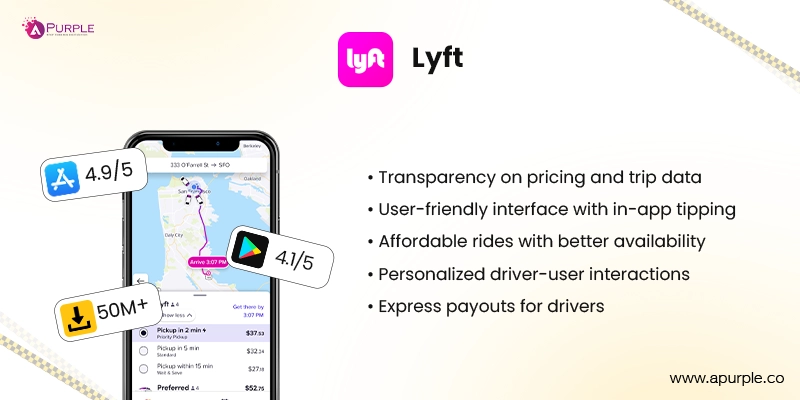
The first app in our list of best Uber alternatives is Lyft, which is a US-focused ride-hailing app popular for its community-driven branding and providing a rider-first experience. The difference between Uber and Lyft is that Lyft has preferred to double down on its operational strength in North America, instead of putting efforts into global domination.
What Are the Key Features Offered by Lyft?
- Offers standard and shared ride options.
- Provides tipping systems for drivers.
- Gives driver’s incentives based on circumstances.
- Allows options to schedule future rides.
- Provides safety tools for app users, including ride tracking and emergency help.
- Supports a strong driver-rider feedback loop.
What Are the Pros and Cons of Lyft?
| Pros | Cons |
|---|---|
| The app interface is simple and easy to use. | Chances of ride cancellation and long wait time. |
| Provides multiple ride options to users. | Availability is limited in smaller cities. |
| Ensure complete transparency for fare estimation. | Price fluctuates; it may vary based on demand. |
| Integrated strong safety features. | Extra services demand additional fees. |
Available On :
What should startups learn from Lyft?
Focusing on depth and experience in only one market before scaling globally can lead to rapid success.
2. Bolt
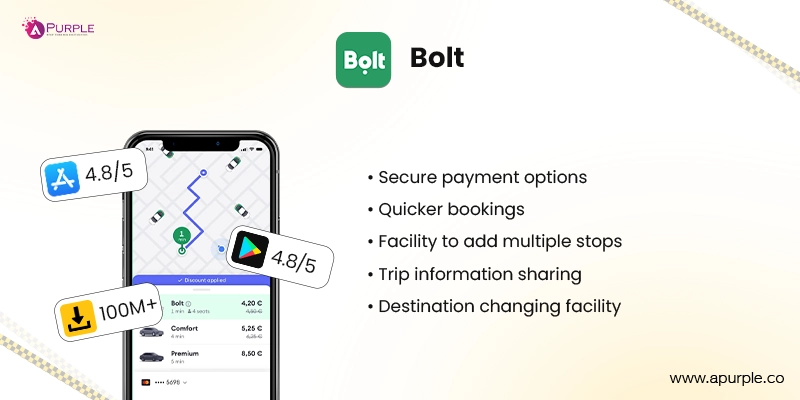
Bolt is a European-based ride-hailing platform which is growing fast in the industry. The bolt business model is popular for its low commissions and aggressive pricing. Its core strategy is to attract drivers by giving maximum earning potential rather than overloading an app with multiple features.
What Are the Key Features Offered by Bolt?
- Offers various ride options, including Bolt Base, Economy, and XL.
- Driver commission is very low.
- Supports micromobility options for app users.
- Easy and fast onboarding for drivers.
- Popular for providing budget-friendly rides and reliable services.
What Are the Pros and Cons of Bolt?
| Pros | Cons |
|---|---|
| Provides eco-friendly options for a ride. | Ride options are limited compared to other competitors. |
| For traditional rides, it came as the cheaper option. | Pricing gets increased during peak hours. |
| In Europe and Africa, availability is wide. | In some regions, its availability is zero. |
| Extra benefits access with Bolt Plus membership. | Service issues occur occasionally. |
Available On :
What should startups learn from Bolt?
As a leading startup consulting firm, we must say with an example of Bolt that not every time a business can go with heavy branding, you can build revenue with better unit economics also.
3. Ola
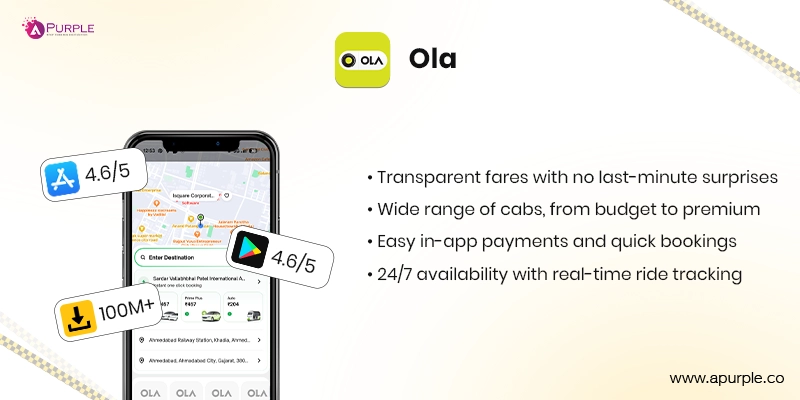
Ola is India’s largest mobility competitor, developed for high-volume and price-sensitive markets. It successfully localized itself as a great Uber alternative for growing economies.
What Are the Key Features Offered by Ola?
- Wide pricing tiers with different vehicle types, such as auto, bike, and cab.
- Enables in-app UPI payments and offers cash payment options.
- Provides EV integration.
- The regional language support is very strong.
- Best solution for corporate rides.
What Are the Pros and Cons of Ola?
| Pros | Cons |
|---|---|
| Provide multiple vehicle options. | Pricing gets increased during peak hours. |
| The app interface is highly user-friendly. | Location availability is limited to India and selected areas. |
| Offers GPS tracking in real-time. | Possibilities of driver cancellations. |
| Payment options are super convenient. | Charges extra fees for waiting periods. |
Available On :
What should startups learn from Ola?
When competing in a growing market, localization can compete well with any other app’s perfection.
4. Grab
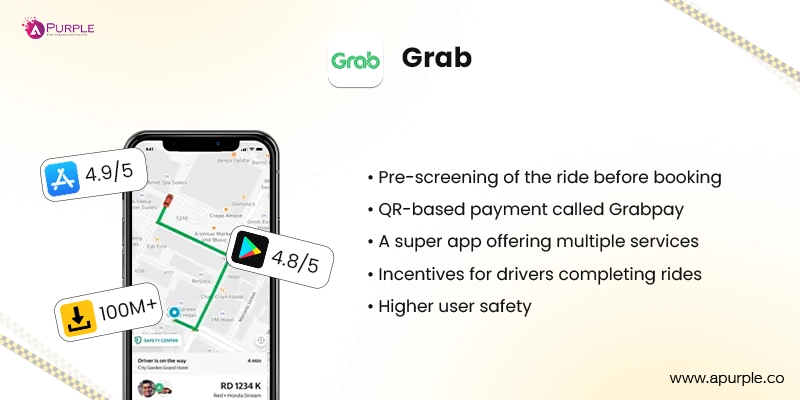
At first, Grab provided only ride-hailing services to Southeast Asia’s market, but after investing in super app development, it expanded services in logistics, food, delivery, digital payments, and so on. For Grab, the mobility business became its entry point, not the end product.
What Are the Key Features Offered by Grab?
- Provides super app services like food delivery and payments with ride-hailing.
- Supports in-app wallets for seamless payment transactions.
- Offers various subscription programs.
- Multiple vehicle options, including 2-wheelers and premium cars.
What Are the Pros and Cons of Grab?
| Pros | Cons |
|---|---|
| Multiple services in only one app. | Limited to only Southeast Asia regions. |
| Accepts cashless payments seamlessly. | App stability issues occur on an occasional basis. |
| Integrates other services seamlessly. | Costs extra to experience premium services. |
Available On :
What should startups learn from Grab?
You can just enter the market with any one service and build a brand, expanding is good when you earn enough to bear investment, as well as unpredictable losses.
5. Careem
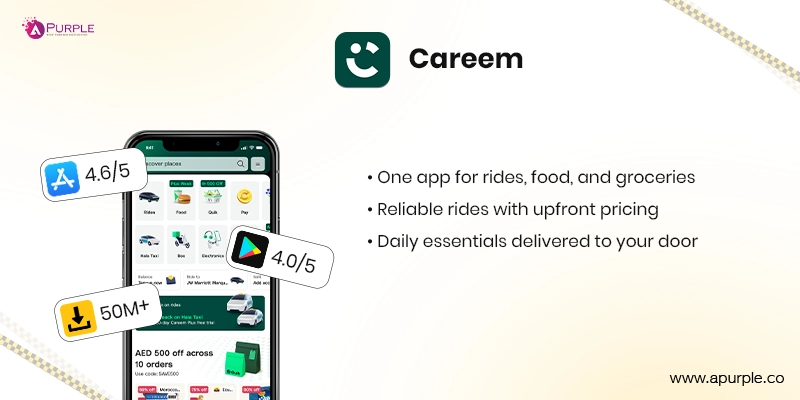
Careem offers super app services in the Middle East countries such as the UAE, Saudi Arabia, Jordan, etc. At first, it was customized as a ride-hailing services provider, then Careem business model expanded into payment, food delivery, and grocery services. Now, its ride-hailing business is completely acquired by Uber itself.
What Are the Key Features Offered by Careem?
- Enables cash payment options.
- User experience is highly localized.
- Provides female-friendly options to women in terms of security.
- Includes super app services, including food and groceries delivery.
- Customer support is very strong.
What Are the Pros and Cons of Careem?
| Pros | Cons |
|---|---|
| Understands core regional needs with a strong local presence. | As per the city or country, service quality and availability may change. |
| Created bonds with users by understanding cultural and operational sensitivity. | Regulatory and cultural challenges occur in different operating regions. |
| Brand loyalty is highly strong. | Dependency on Uber after an acquisition. |
Available On :
What should startups learn from Careem?
Cultural alignment can connect your product with your target audience easily.
6. DiDi Global
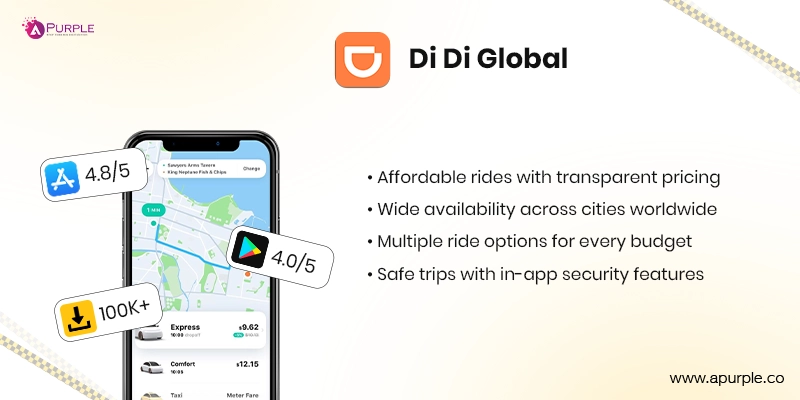
DiDi Global is China’s largest dominating ride-hailing app and one of the world’s largest platforms for mobility that connects millions of users to drivers in multiple countries. Its mobility services are operated in countries such as Argentina, Australia, Brazil, Chile, Colombia, Costa Rica, Ecuador, Egypt, Japan, and more.
What Are the Key Features Offered by DiDi Global?
- Routing is AI-powered and allows smart dispatch, which optimizes trips and reduces waiting time.
- From economy and premium to shared and taxi integrations, it provides multiple ride options.
- For riders and drivers, there are real-time tracking features with safety tools.
What Are the Pros and Cons of DiDi Global?
| Pros | Cons |
|---|---|
| The user base is very strong and huge, which is a benefit while scaling. | Regulatory scrutiny is heavy and hard, especially in the Chinese and overseas regions. |
| AI and data-driven operations are strong. | Operating cost is high, which causes profitability pressure. |
| Provides various services to users globally. | Labor and driver relations are complex. |
Available Different Variants of the DiDi App on iOS and Android, As Per The Respective Country.
What should startups learn from DiDi Global?
Leveraging the benefits of AI and data in early stages can become a competitive advantage in the ride-hailing market with advanced routing, demand prediction, and optimization.
7. Gett
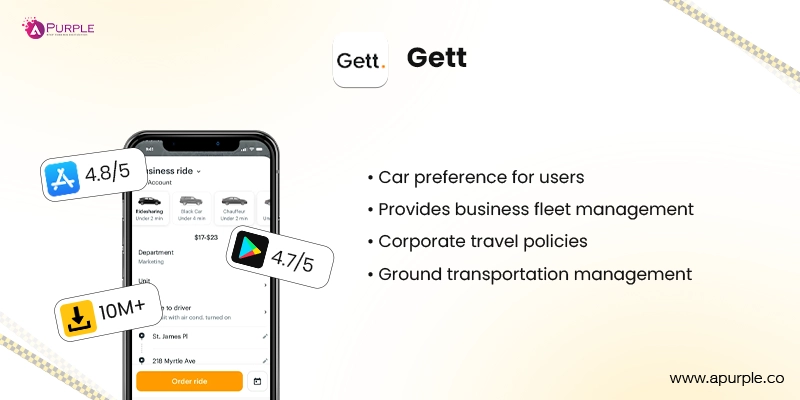
As one of the best Uber alternatives, the Gett ride-hailing app focuses on the B2B market primarily rather than the consumer mass markets. To become the next major player and compete with Uber, they made a move to allow passengers to book rides in advance, up to two weeks.
What Are the Key Features Offered by Gett?
- Provides dedicated corporate dashboards.
- Supports a fixed pricing model.
- Follows a taxi-first approach.
- Offers SLA-based services.
What Are the Pros and Cons of Gett?
| Pros | Cons |
|---|---|
| Supports a fixed pricing model with surge charges. | Availability is very limited in non-business areas. |
| Expense management is super easy for businesses. | Ride options are few compared to other competitors. |
| Punctuality and professionalism are high. | Not so popular in the US territory. |
| Supports advance bookings. | Premium services can be expensive. |
Available On :
What should startups learn from DiDi Global?
Investing in a B2B mobility model may not provide virality, but for sure, it provides stability.
8. BlaBlaCar
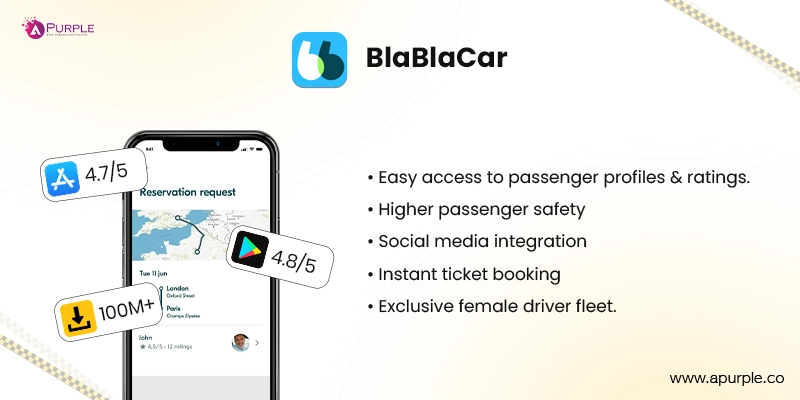
As one of the great alternatives to Uber, BlaBlaCar provides services for long-distance travel. It leverages the community-powered carpooling model and offers travel for long distances to users.
What Are the Key Features Offered by BlaBlaCar?
- Provides long-distance rides through an online app.
- Showcase community ratings to increase trust.
- It’s a successful cost-sharing model for travel.
- Offers bus as well as carpool integration.
What Are the Pros and Cons of BlaBlaCar?
| Pros | Cons |
|---|---|
| Supports the asset-light model. | Not made for urban rides. |
| The trust system is highly strong due to the community. | Frequency is very limited. |
| Provides sustainable options for travel. | Highly dependent on app users and their needs. |
Available On :
What should startups learn from BlaBlaCar?
A strong community trust is enough to replace heavy infrastructure in the competition.
9. Free Now
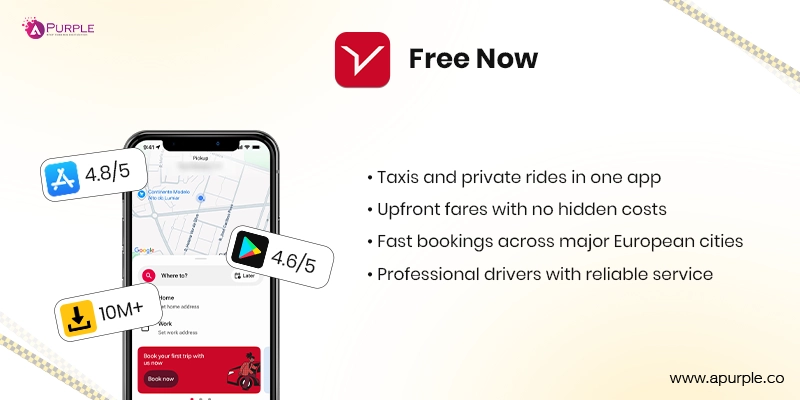
Free Now ride-hailing app works by aggregating various taxis and private rides into one single platform throughout the European regions. This Uber alternative strictly follows all the regulatory compliance required for the European market. Now, it’s completely acquired by Lyft.
What Are the Key Features Offered by Free Now?
- Supports taxi + ride-hailing model for travel.
- Unified payment system for all.
- Provides multi-city support in European countries like Germany, the UK, Ireland, France, & Spain.
- Allow building corporate accounts in the app.
What Are the Pros and Cons of Free Now?
| Pros | Cons |
|---|---|
| Leverage existing taxis to provide vehicles for users. | Over supply systems, control is less. |
| Expansion is fast. | User experience is highly fragmented. |
| Features are regulatory-friendly. | Margin is very low. |
Available On :
What should startups learn from “Free Now”?
In regulated markets, going with an aggregation model can increase the chances of beating disruptions.
You May Want to Read On: Taxi App Development
10. Cabify
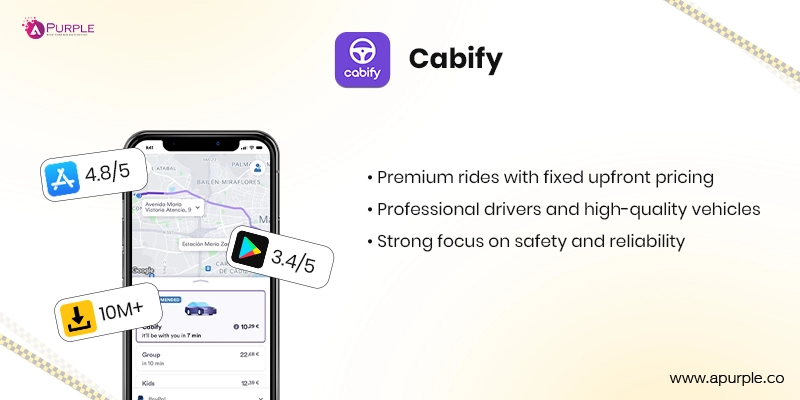
For the Spanish-speaking markets, Cabify focuses on serving premium and corporate rides. Mostly prioritize performing sustainable rides and showcase upfront pricing without charging any kind of hidden fees.
What Are the Key Features Offered by Cabify?
- Provides premium vehicles for rides.
- Allow creating corporate accounts.
- Supports a fixed pricing model with no hidden charges.
- Drivers are following all the quality standards.
What Are the Pros and Cons of Cabify?
| Pros | Cons |
|---|---|
| Provides professional drivers for rides and gives high-quality services. | The cost is high compared to local taxi fares. |
| Gives transparent pricing to everybody with zero hidden charges. | Availability is limited outside the major cities. |
| Easy booking, which makes it user-friendly. | Waiting time is long where the population is less. |
Available On :
What should startups learn from Cabify?
To attract high-value users, implementing quality-first positioning can work.
11. Gojek
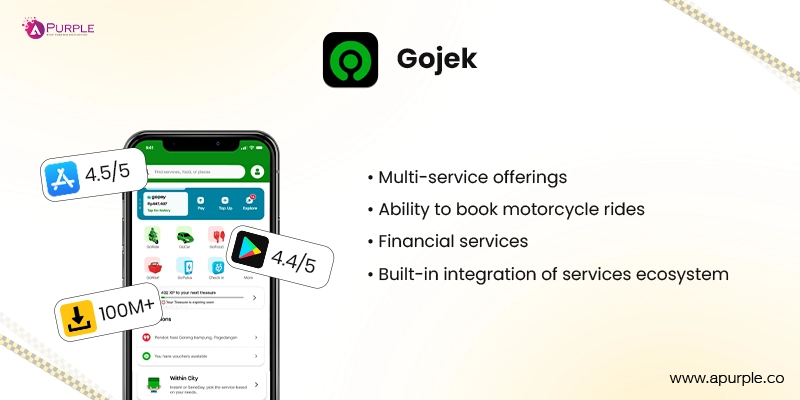
At first, the Gojek ride-hailing app model launched with bike taxis, and it gained popularity and good revenue, so it expanded and became a multi-service super app.
What Are the Key Features Offered by Gojek?
- Offers bike and car options for the ride.
- Enables digital payments for app users.
- Seamless API integrations.
What Are the Pros and Cons of Gojek?
| Pros | Cons |
|---|---|
| Daily usage is very high due to the bike option. | The complexity level is high to ensure smooth operations. |
| Revenue comes from diverse ways. | Burn is heavy. |
| Dominance in the local areas is very high. | Replication is very hard. |
Available On :
What should startups learn from Gojek?
If you are building an app like Uber, then you can definitely note this point from Gojek that solving daily problems can work better than only serving transportation.
12. inDrive
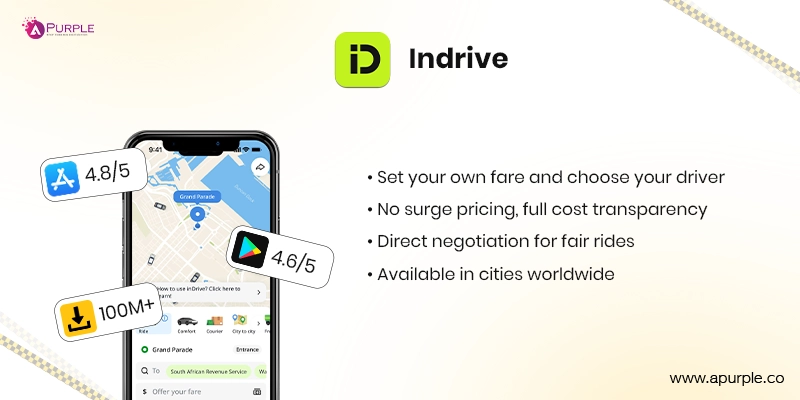
The very unique thing about an inDrive ride-hailing app is that it allows drivers and riders to negotiate ride fares as per their terms. This feature of inDrive makes it one of the best Uber alternatives when you are looking to launch something different from other competitors. It was first launched in Russia and expanded its services to 40+ countries, including the US market.
What Are the Key Features Offered by inDrive?
- Riders (passengers) have the freedom to suggest their own fares for the ride.
- Drivers have the full right to negotiate or give any counteroffer.
- The commission is so minimal compared to other competitors.
What are the Pros and Cons of inDrive?
| Pros | Cons |
|---|---|
| Prices are flexible with fair negotiations. | Availability in the US market is limited. |
| The fare-setting process is highly transparent. | Feature integrations are very limited compared to larger apps in the market. |
| Gives better control to app users for ride costs. | The driver network is limited in some areas. |
Available On :
What should startups learn from inDrive?
Giving control to app users can lead to a rapid increase in the number of app downloads. If you are looking to build an app like inDrive but with a limited budget, then you can try developing an inDrive clone as a cheaper and successful option.
13. Curb
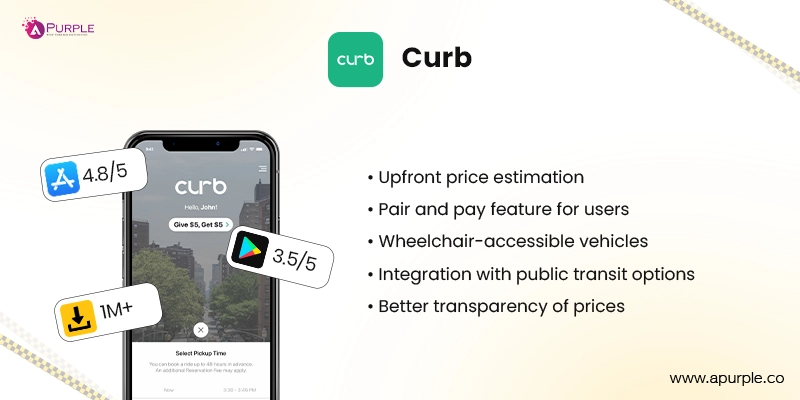
Curb is another alternative to Uber that you can consider in the US, which partners with independent contractors, licensed taxi companies, and drivers. It has a network of over 100,000 drivers across the United States as well as in the UK, providing service in over 65 major cities.
What Are the Key Features Offered by Curb?
- Licensed-based taxi network.
- Cashless payment options.
- Integration with public transit options.
- Provides vehicles that are accessible by wheelchair.
What Are the Pros and Cons of Curb?
| Pros | Cons |
|---|---|
| A complete regulatory alignment. | Features are limited compared to competitors. |
| Multiple payment options for paying fares. | Chances of booking fees on the platform. |
| Service supply is stable. | Prices may be high in some of the regions. |
Available On :
What should startups learn from Curb?
To earn profit by building an Uber alternative, modernizing legacy systems can be lucrative for startups.
14. Wingz
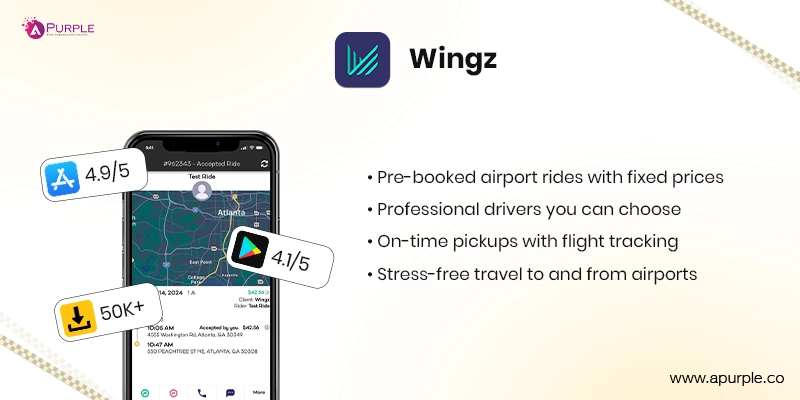
Wingz model provides core services for scheduling airport rides in advance with fixed pricing in many USA cities across California, Florida, Oregon, Texas, and Washington.
What Are the Key Features Offered by Wingz?
- Passengers can schedule their rides up to 2 months in advance.
- Riders can book the same driver for future trips.
- Fixed pricing model with no extra charges.
What Are the Pros and Cons of Wingz?
| Pros | Cons |
|---|---|
| Pre-scheduling is available up to 2 months. | Limited to US-specific cities. |
| There are no surge rates; it works on fixed rates. | Does not provide any on-demand services. |
| Best for airport travel. | For last-minute changes, it costs a lot. |
Available On :
What should startups learn from Wingz?
With the narrow niche model, ride-hailing apps can easily deliver strong margins.
15. Yango
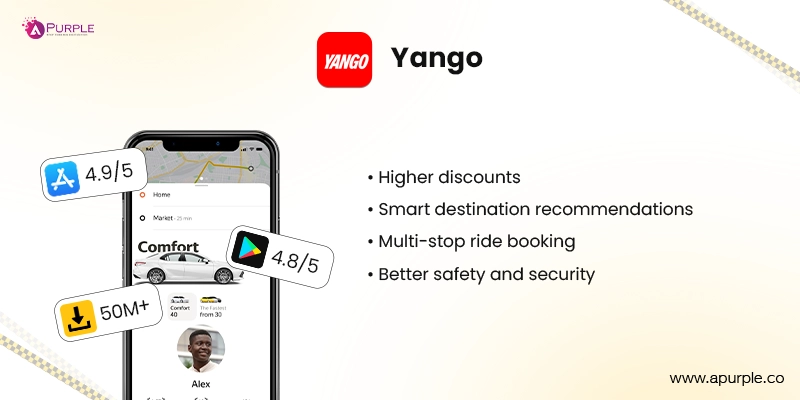
The next best Uber alternative is Yango, which provides ride-hailing and food delivery services in 19 countries, prioritizing regions such as Ghana, Cameroon, Zambia, and Senegal. It is a significant urban mobility and logistics platform that works across Europe, Latin America, and Africa.
What Are the Key Features Offered by Yango?
- Works on a local partnership model.
- Supports multiple languages in the platform.
- The pricing structure is based on the regions.
What Are the Pros and Cons of Yango?
| Pros | Cons |
|---|---|
| Localization of the platform is rapid. | High dependency on brands. |
| A complete technology efficiency. | Possibilities of regulatory risks. |
| Serves scalable operations. | Volatile based on markets. |
Available On :
What should startups learn from Yango?
Integrating tech with local operations is a great combo to win in the ride-hailing market.
16. Co-op Ride
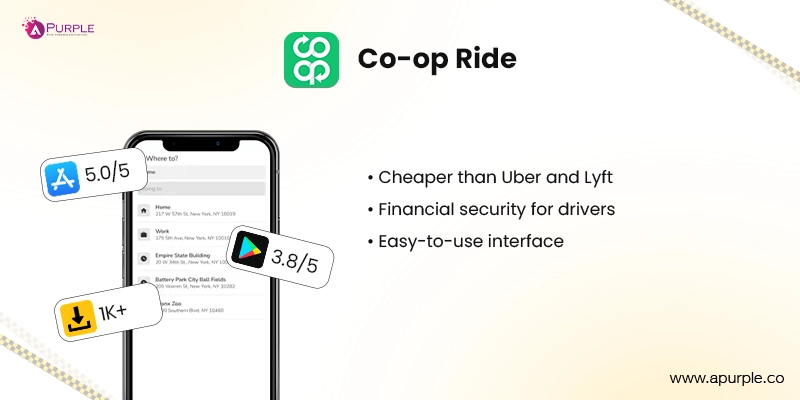
Co-op Ride, also known as the Driver’s Cooperative ride-hailing application. It is highly active and operational in Denver and New York, providing drivers 85-90% of net profits, which is a minimum of USD 30 per hour.
What Are the Key Features Offered by Co-op Ride?
- Complete ownership is managed by drivers.
- Provides transparent commissions to all drivers.
- Commission fees are very low compared to Uber or Lyft.
What Are the Pros and Cons of Co-op Ride?
| Pros | Cons |
|---|---|
| Provides fair earnings to drivers. | Reach is not high, limited to some popular U.S. cities. |
| No surge pricing policy in peak hours. | Vehicle availability is too low. |
| All the operations are transparent and ethical. | The rider base is very small. |
Available On :
What should startups learn from Co-op Ride?
For getting long-term loyalty from drivers in a ride-hailing platform, the ownership model works the best.
17. Blacklane
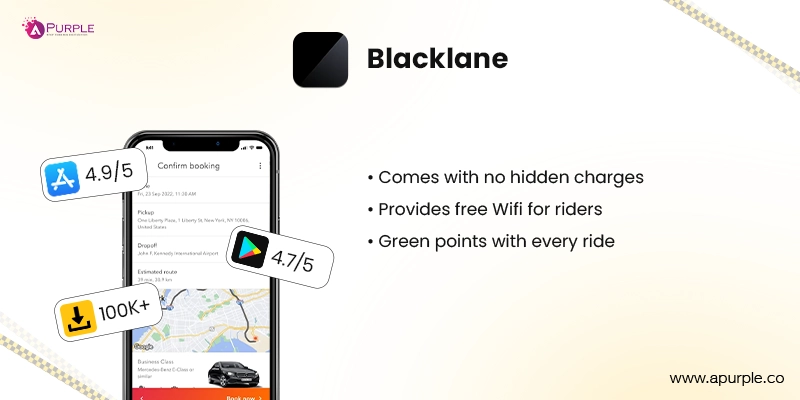
Blacklane is the Uber alternative in terms of providing luxury chauffeur services. It operates globally, particularly in the luxury chauffeur segment only.
What Are the Key Features Offered by Blacklane?
- Provide premium vehicles for the ride.
- Collaborated with professional chauffeurs.
- Mostly worked for airport transfers.
- Enables corporate bookings for users.
What Are the Pros and Cons of Blacklane?
| Pros | Cons |
|---|---|
| Provides high margins. | The target audience is very limited. |
| Strong brand impact in popular cities. | No opportunity to get mass scaling. |
| Offers reliable and consistent services to users. | With premium vehicles, pricing is also high. |
Available On :
What should startups learn from Blacklane?
Targeting only one niche and providing premium, focused services simplifies operational burdens for the startups.
18. Alto
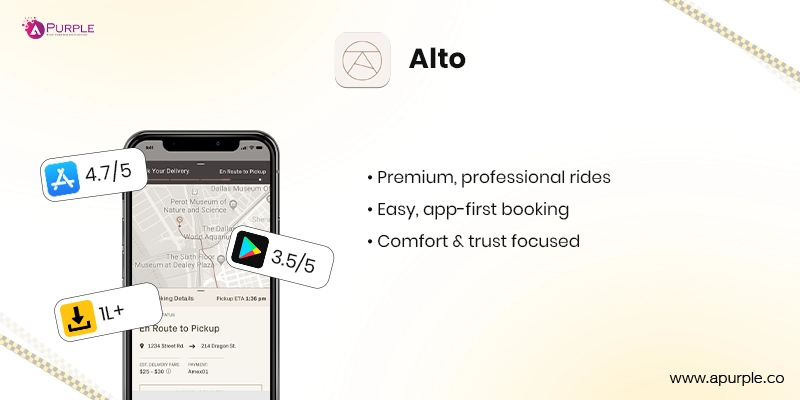
Alto is a Dallas-based Uber alternative that claims to be one of the most secure ridesharing services in the US. It became one of the first companies in the US to hire W-2 drivers. Alto is operated in popular U.S. cities such as Dallas, Houston, Los Angeles, Miami, and Washington, D.C.
What Are the Key Features Offered by Alto?
- Provides a monthly subscription facility.
- Offers premium rides to passengers.
- Work on a safety-first model.
What Are the Pros and Cons of Alto?
| Pros | Cons |
|---|---|
| Provides service consistency. | Highly dependent on assets. |
| Brand control is very strong. | Expansion speed is very slow. |
| Gained high customer trust due to security. | The cost is high. |
Available On :
What should startups learn from Alto?
From this Uber alternative, startups must learn that control of course improves quality, but simultaneously, it increases cost.
Final Thoughts: Choosing the Right Uber Alternative Model for Your Startup
We can not say that there is only one decoded formula to build the competitive Uber alternatives. The real success depends on how you perfectly adapt the Uber business model and launch it for the specific market, audience, or problem as it did by the examples mentioned in this blog. Whether it’s about maintaining local regulations, driver economics, providing premium services, or niche mobility needs, choosing the right business path with an accurate strategy is a must. The real benefits lie in choosing a business model that actually aligns with your startup’s strengths instead of just copying it from Uber.
At aPurple, we help startups like you to leverage these insights and make the right execution. As a leading mobile app development company, we work closely with startup founders whose priority is to work on the mobility segment. We focus on building scalable, market-ready ride-hailing platforms backed by the right tech, architecture, and unit economics. So, if you are one of them and exploring the best Uber alternative and want clarity on what to build and what to avoid, then we are here to help you move faster with the right confidence.
Frequently Asked Questions (FAQs)
We can not say there is a single “best” Uber alternative. But we can consider popular apps that follow Uber business models, such as Lyft, Bolt, Ola, and Grab, that perform best in their respective regions.
The Uber app development cost typically ranges from USD 10,000 to 150,000+ approximately, which varies based on factors such as app complexity, feature level, chosen platforms (iOS/Android), real-time tracking, payment integrations, and more.
Most of the Uber alternatives generally offer lower fares or flexible pricing, but the availability of ride-hailing platform services varies based on city and region. There are many apps that focus on niche markets rather than expanding to global coverage.
In real ranking, personal vehicles are the most used transportation mode in the USA, after that, public transport can be considered as the 2nd preferred mode. Later, ride-hailing apps like Uber and Lyft were widely used in urban areas.
Both Bolt and Uber provide safety features such as ride tracking and emergency support. Safety is largely based on the local regulations, driver screening, and in-app controls, rather than the platform alone.