Updated Date: Jan 16, 2026
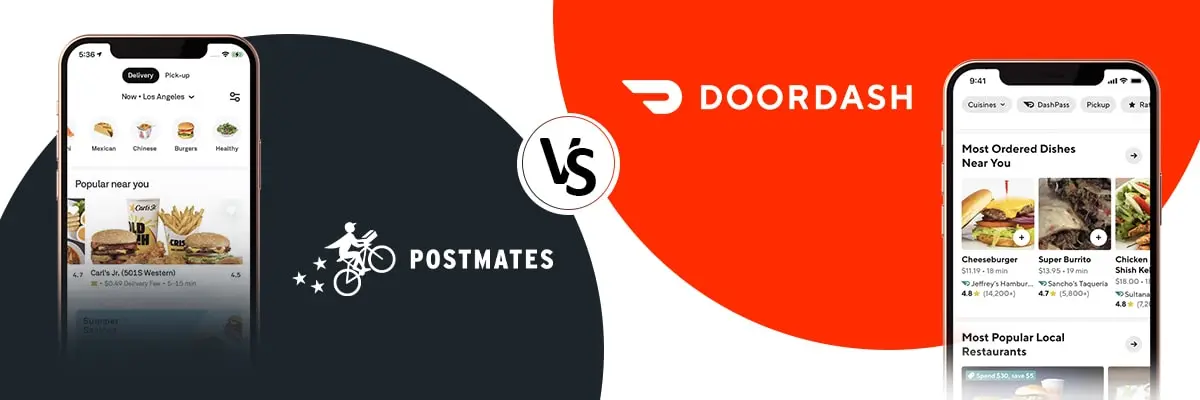
Choosing the right food delivery platform is a matter of earnings, customer experience, or business growth. That’s why most people get confused between the top on-demand delivery leaders, Postmates vs. DoorDash.
From delivery fees and payout structures to customer reach and operational flexibility, each food delivery app, comes with its own set of advantages and disadvantages. So, whether you’re:
- A driver looking for flexibility against payouts
- A customer deciding between faster delivery and better deals
- A restaurant owner looking for a wider reach and lower commissions
- Or an entrepreneur finding an ideal food delivery model to create an app
Then, don’t worry! You’re in the right place. This side-by-side comparison breaks down how Postmates and DoorDash differ from each other, what similarities they share, and which one is best for you to pick. Let’s understand how both platforms stack up in real-world use.
Postmates vs DoorDash: Quick Comparison
Postmates, now acquired by Uber Eats, is an on-demand delivery platform that allows users to order food, groceries, and everyday essentials from local merchants. Most liked for its flexibility and wide range of stores, Postmates does not deliver orders from restaurants only; they give versatile options for customers and independent drivers. As it now operates under Uber Eats, Postmates also benefits from Uber’s logistics and delivery infrastructure.
DoorDash is one of the leading food delivery as well as local commerce platforms, but it is primarily focused on restaurant-to-customer-based deliveries. It is widely recognized by people for its strong market presence, fast delivery network, and robust merchant tools. Basically, the DoorDash business model gives a seamless platform for customers to directly connect with the restaurant while offering structured earning opportunities for drivers and scalable growth options for restaurant businesses.
May you get an overview of both the apps; let’s do a quick comparison of key differences between DoorDash and Postmates.
| Aspects | Postmates | DoorDash |
|---|---|---|
| Primary Focus | Food, groceries, and everyday essentials | Primarily established for food delivery |
| Market Presence | Merged with Uber Eats | Strong independent market leader with a wide range |
| Delivery Coverage | Highly urban-focused | Urban and suburban reach |
| Driver Flexibility | High, task-based deliveries | High, with scheduled and on-demand options |
| Customer Experience | Wide merchant variety | Faster delivery and better restaurant availability |
| Restaurant Reach | Moderate, through Uber Eats | Extensive restaurant network |
| Subscription Program | Postmates Unlimited | DashPass |
| Best Suited For | Multi-category delivery needs | High-volume food delivery |
DoorDash vs. Postmates: Key Platform Statistics [Check What Number Says]
When comparing Postmates and DoorDash, having an eye on both apps’ numbers gets you towards the clear picture of where each of them actually stands in 2026. These statistics help startups understand market reach, user adoption, growth trends, and the competitive landscape.
a) User Base & Geographic Coverage
- DoorDash is one of the most widely adopted food delivery platforms on a global level, with 46.3 million active users and operations across 40+ countries, including the USA, Canada, Australia, Japan, Germany, and more.
- Separate data on Postmates’ active user count is no longer reported, as its logistics and delivery operations are largely merged with Uber Eats. To compare the data of Uber Eats with the DoorDash platform, you can check our latest blog on Uber Eats vs. DoorDash.
b) Market Share in the U.S. Food Delivery Space
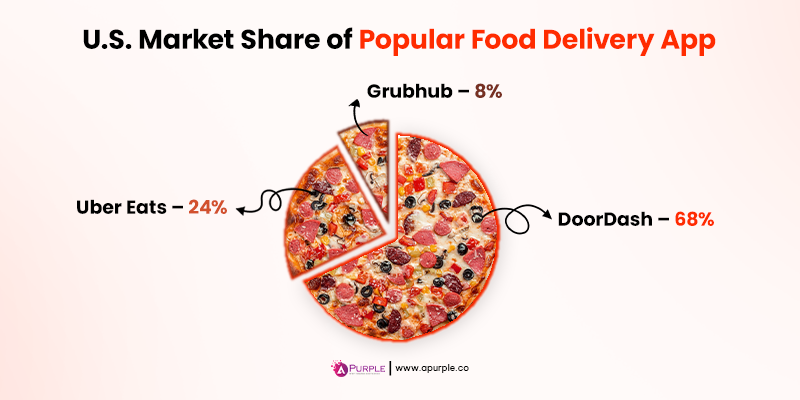
- DoorDash is dominating the U.S. food delivery market with ~68 % share, significantly larger than any other on-demand delivery service competitor (DemandSage).
- Postmates only holds a single-digit share of ~2 % in the U.S. meal delivery market, as most of the volume is counted under Uber Eats’ 23 % share due to the merger.
c) Projected Revenue for DoorDash vs Postmates (2024–2027)
Here’s the revenue comparison of both platforms from 2024 to 2027.
| Year | Estimated DoorDash Revenue | Postmates Revenue (Estimated as part of Uber Eats) |
|---|---|---|
| 2024 | $10.7 B (reported) in annual revenue | ~$1.0 B estimated annual revenue (peak 2025, pre-acquisition independent estimates) |
| 2025 | ~$13.8 B – $13.756 B (analyst forecast) | ~ $1.0 B – $1.1 B approximate |
| 2026 | ~$17.8 B projected (analyst estimate) | Not officially disclosed, as it was part of Uber Eats delivery revenue, which was ~$13.7 B in 2024 |
| 2027 | ~$21.2 B projected (analyst estimates based on growth trends) | Likely to continue moderate growth as part of the Uber Eats segment |
Postmates vs DoorDash for Drivers
For delivery drivers, the right platform is one that gives greater earning potential, flexibility, and order consistency. While both Postmates and DoorDash offer gig-based work, their driver experiences vary in terms of structure and predictability.
Key Differences Between DoorDash and Postmates For Drivers
| Factor | Postmates | DoorDash |
|---|---|---|
| Sign-Up Process | Easy and quick onboarding with minimal restrictions. | Asks for background & DMV checks for seamless onboarding. |
| Earnings Model |
Pay is based on time, distance, and tips [Generally, $19/hour, but can range from $10–$25+, depending on factors]. |
Base pay + tips + structured incentives [Average, $18.45/hour, but varies between $15–$20, depending on factors ]. |
| Incentives | Price increases at the time of peak demand. | Allows peak time pay, challenges, and bonuses. |
| Scheduling | Fully on-demand, no features for scheduling. | On-demand as well as giving options for scheduled blocks. |
| Order Volume | High in dense urban areas. | Higher and more consistent nationwide. |
| Driver App Experience | Simple and super flexible. | Feature-rich, it also gives heat maps and scheduling tools. |
Quick Driver Takeaway
- Postmates suits drivers who prefer maximum flexibility and work short, spontaneous shifts.
- DoorDash is better for drivers who are looking for steady orders, clearer incentives, and predictable earnings, mostly in suburban and high-demand markets.
- Startup Insight: As a leading mobile app development company, we suggest that driver retention in your platform will improve when it balances flexibility with earning visibility. This is something founders must prioritize when designing a delivery or logistics app.
Consider DoorDash; if you are looking for consistency, pick Postmates if you value flexibility.
Postmates vs DoorDash for Customers
For customers, the best food delivery apps are those that offer speed, reasonable pricing, availability, and a great user experience. While both platforms promise convenience, they differ in focus and service consistency.
Key Differences Between DoorDash and Postmates For Customers
| Factor | Postmates | DoorDash |
|---|---|---|
| Service Scope | Food, groceries, and routine essentials. | Primarily focused on food delivery. |
| Restaurant Availability | Moderate; it may vary city by city. | Extensive, strong impression in local coverage. |
| Delivery Speed | Good in urban areas. | Generally faster and more consistent. |
| Pricing & Fees | Delivery and service fees are different depending on the circumstances. | Transparent fees with options for DashPass savings. |
| Subscription Plan | Postmates Unlimited (via Uber Eats). | DashPass. |
Quick Customer Takeaway
- Postmates appeals to users who seek more than just food delivery, especially in large urban cities.
- DoorDash is ideal for customers who prioritize faster delivery, a wider restaurant choice, and predictable pricing.
- Startup Insight: Our experts from the startup consulting services segment suggest that customers prefer to stick with platforms that reduce friction and provide clear pricing, fast checkout, accurate ETAs, etc.
If you came for only food-focused convenience, then go for DoorDash. But if your focus is multi-category delivery, then choose Postmates.
Postmates vs. DoorDash for Restaurants & Businesses
For restaurants and local businesses, picking one delivery platform is a matter of visibility, margins, and operational efficiency. Here’s how both platforms compare from a merchant’s perspective.
Key Differences Between Postmates and DoorDash For Restaurants & Businesses
| Factor | Postmates | DoorDash |
|---|---|---|
| Merchant Reach | Moderate, now integrated with the Uber Eats ecosystem. | Very high, especially in the USA. |
| Commission Structure | Changes as per the circumstances, often higher for visibility. | Tiered plans with flexible commission options. |
| Order Volume Potential | Strong in selected metro areas. | Consistent, high-volume throughout the nation. |
| Merchant Tools | Basic analytics and order management. | Advanced dashboards, insights, and POS integrations. |
| Brand Visibility | Lower standalone visibility. | Strong in-app discovery and promotion capabilities. |
Quick Business Takeaway
- Postmates works well for those restaurants and businesses that want to target urban, multi-category delivery demand.
- DoorDash is highly suitable for restaurants looking to scale, with a predictable order flow and strong integration with merchant tools.
- Startup Insight: Considering how DoorDash works, startups that want to build a marketplace app should learn merchant-first tooling that highlights how analytics, integrations, and pricing flexibility can drive platform adoption.
Honestly, choose DoorDash to experience strong reach and growth.
How to Build an App Like Postmates or DoorDash? [Tips For Startups]
Food delivery app development, similar to Postmates or DoorDash, requires more than just copying their features. It demands a scalable foundation, a clear MVP scope, and operational readiness from the day you begin your project for the on-demand industry. As a startup, your goal must be to validate demand quickly while keeping your solution flexible to adapt to future growth. Here are the key points you should consider when building an app like Postmates or DoorDash.
- Start with a focused MVP with a user app, driver app, restaurant panel, and an admin dashboard; nothing more to launch.
- Keep scalability in mind and design accordingly, use cloud infrastructure and modular architecture to support growth across cities and regions.
- Choose a flexible tech stack such as a cross-platform framework with real-time APIs for tracking and notifications.
- Enable secure, multi-option payment ways, including cards, wallets, and in-app payments, with strong fraud protection.
- Optimize logistics and last-mile delivery with smart order allocation, route optimization, and live order tracking for drivers and customers.
- M/ake sure to implement compliance and data security measures, following local regulations, payment standards, and user data protection norms.
Final Verdict: Postmates vs DoorDash
In the on-demand delivery sector, Postmates and DoorDash serve different needs. DoorDash stands out for its faster deliveries, wide restaurant network, and structured pricing, making it the best choice for customers and restaurants who want consistency. On the other hand, Postmates provides great flexibility across different categories, appealing to users who value variety in services. The right choice basically depends on whether your users want speed, reach, or versatility.
For startup founders, the real takeaway is to understand why the Postmates and DoorDash clone or business models work. Building a successful on-demand delivery solution requires the right mixture of user experience, logistics, and technology. And you can find all these by partnering with aPurple experts. We help businesses design and develop reliable delivery platforms that match unique market needs and business growth.
Frequently Asked Questions (FAQs)