Updated Date: Feb 11, 2026
You’ve got the logistics app idea, but don’t know what comes next, right?
For founders, the main challenge is not technology. The real issue is deciding which operational pain point to solve first. Early feature choices affect cost, build time, and long-term adoption. A wrong start leads you to low usage after a few shipments.
Logistics apps no longer stop at tracking screens. They go beyond shipment status, route maps, and delivery confirmation. Today, logistics app development supports full operational control. Teams expect real-time fleet visibility, AI-driven route planning, automated proof of delivery, and early delay alerts.
This rapid shift can cause confusion for you. When teams try to build everything at once, products break. Interfaces feel heavy. Data stays scattered. Drivers fall back to spreadsheets and calls.
Logistics app development now requires focus. You must identify the first bottleneck to remove and need a clean data sync across systems. You need GPS tracking to gain drivers’ trust. A focused build helps you validate faster and control costs. You gain operational trust before adding layers. This approach creates momentum instead of friction.
This guide walks you through costs, development phases, and scalable revenue paths so you start with clarity and grow with confidence.
What is Logistics App Development?
Logistics app development is the process of building a custom app for digitizing, managing, optimizing, and automating supply chain, delivery, warehouse, fleet, and transportation operations.
Developing a logistics app streamlines end-to-end workflows (delivery-dispatch), enhances efficiency, reduces cost, and improves customer visibility via features such as warehouse management systems, real-time tracking, GPS, inventory control, route planning, driver management, etc.
Moreover, in fast-moving countries like the USA, Canada, UK, Australia, KSA, and UAE, with vast geographical distances and ecommerce volume, and rapidly growing logistics hubs, the development of transport & logistics apps is crucial to handle high-volume demand.
Key functions of logistics app:
- Order Management: Manages documentation, schedules, bookings, and more.
- Warehouse Management: Oversees end-to-end warehouse or distribution center operations. Includes storage, picking, inventory control, packing, and shipping.
- Real-Time Tracking: Allows location tracking of vehicles & shipments using GPS.
- Route Optimization: Determines the most efficient and cost-effective path for reduced operational costs and improved driver productivity.
- Fleet Management: Tracks vehicle health, maintenance alerts, and driver behavior
Market Statistics Regarding the Logistics Industry
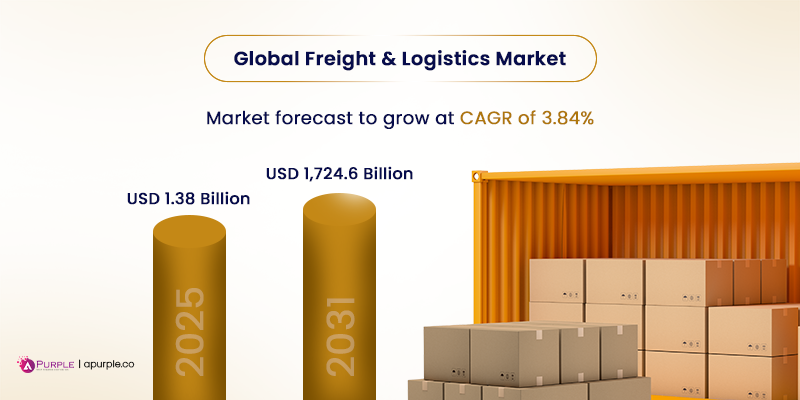
- The logistics industry is expected to reach USD 1,724.6 billion by 2031 with a CAGR of 3.8%.
- The global logistics wholesale and retail trade is forecast to grow at a 4.05% CAGR between 2026 and 2031.
- Logistics costs account for 10-25% of the total business expenses.
What Are the Types of Logistics App Development?
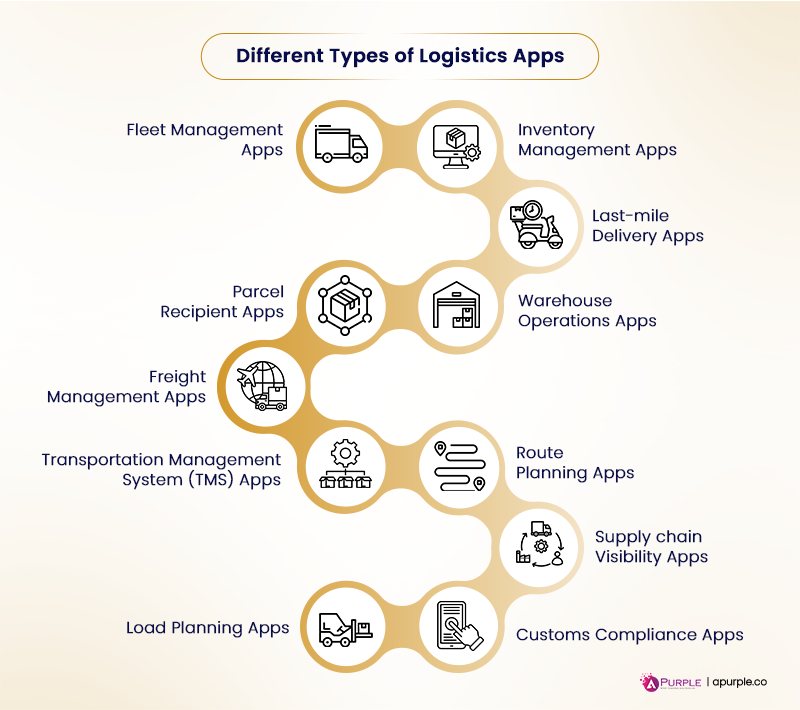
Logistics application development covers multiple use cases. Your logistics app category is determined by the operations and workflow. Choosing the right model helps you with the investment you want.
Here are the main categories you should know about before investing in a logistics app:
| Type | Purpose | Features |
|---|---|---|
| Fleet management apps | Fleet management mobile app development improves efficiency and reduces delivery time with operational costs. |
|
| Inventory management apps | Inventory management through mobile app development for logistics reduce errors and streamline oprations. You can improve order fulfilment rates and provide real-time visibility. |
|
| Last-mile delivery apps | This type of logistic apps streamlines communication with users and reduces delivery costs. You can easily track real-time updates and improve operational efficiency. |
|
| Warehouse operations apps | Integration with WMS (Warehouse Management Systems) and barcode scanning streamlines workflows and automates tasks. Also, temperature monitoring and employee task management improve warehouse performance. |
|
| Parcel recipient apps | This type of logistics app development provides real-time parcel tracking and delivery notifications, improving transparency. The features of the parcel recipient build brand trust through the support it provides. |
|
| Freight management apps | If you’re into cargo deals, a freight management system makes ship tracking and cargo management easy. Also, this tracking helps for sensitive goods in different temperatures |
|
| Transportation management system (TMS) apps | TMS apps optimize shipping routes and reduce transportation costs through features such as load and route optimization. TMS apps provide carrier selection and management features to improve the supply chain efficiently. |
|
| Route planning apps | Logistics app development for route planning can reduce your operational costs and enhance delivery efficiency. These apps offer features such as real-time traffic monitoring and ETA calculations to improve route planning. |
|
| Supply chain visibility apps | These types of logistics application development are used to enhance visibility in the supply chain. Features like demand forecasting and inventory level monitoring reduce disruption and increase efficiency in the supply chain. |
|
| Customs compliance apps | If you want to streamline documentation and improve international trade efficiency, customs compliance apps will work for you with features like automated document preparation, compliance reporting, and audit trail management. |
|
| Load planning apps | Load planning apps improve loading efficiency and utilize vehicle capacity without reducing safety. They include 3D load visualization, cargo space utilization metrics, TMS and WMS integration, and other features. |
|
What are the Must-Have Features of Logistics App Development?
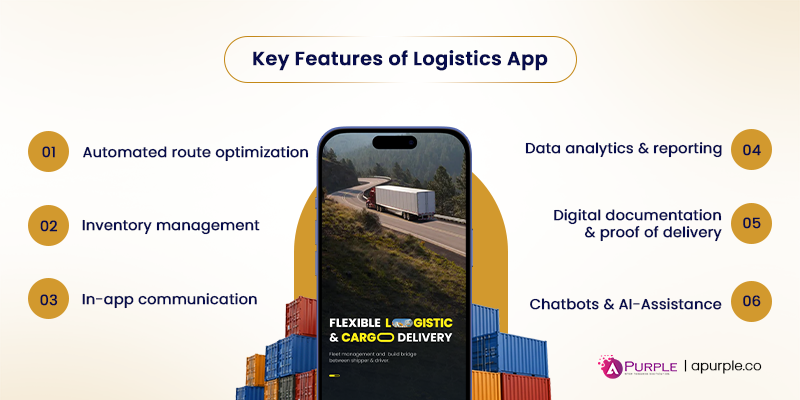
As a leading logistics app development company with years of experience, we have developed this set of features to help startups scale quickly and reduce costs. When planning logistics app development, you must consider this feature set.
-
Automated route optimization
Route optimization helps you to reduce the fuel cost and save time by ensuring routes are short and have less traffic.
-
Inventory management
Tracking of available stock, overstock, and market demand can be centralized through this feature. You can respond proactively and ensure reliable service.
-
In-app communication
In-app communication improves coordination through chat and voice messages. You don’t need to switch apps to communicate with drivers and customers.
-
Data analytics & reporting
Data insights are crucial for logistics application development, as they help improve tracking metrics such as fuel costs, driver performance, and delivery times.
-
Digital documentation & proof of delivery
Digital documentation reduces paperwork, directly cuts unnecessary costs, and provides proof of delivery, such as digital signatures, which builds client trust.
-
Chatbots & AI-assistance
AI-powered chatbots help you to handle customer queries without manual support. It reduces the cost of support teams and improves customer satisfaction.
Tech Stacks for Logistics App Development?
Choosing the right tech stack is an important step that helps to scale and make user friendly logistic app. You need tech tools that help in real-time data processing and secure integrations.
Here is the recommended tech stack for each component of the logistics app.
| Type | Tech Stack | Purpose |
|---|---|---|
| Logistics Mobile App Development | Native: Swift (iOS), Kotlin (Android) Cross Platform: Flutter, React Native |
Swift is used for high performance and Apple ecosystem reach with modern and intuitive UI. Kotlin is used for control over device features that handle complex logistics. Flutter + React Native used for a single codebase and shared logic and UI speed on cross-platform. |
| Logistics Web App Development | Frontend: React.js, Angular Backend: Node.js, Java Spring Boo |
Best for fast dashboards and user flows, also angular for structured enterprise scaling. Node.js is used for real-time data handling, and Java Spring Boot helps with large-scale logistics systems. |
| Cloud Platforms | AWS, Microsoft Azure, Google Cloud | These platforms give you global reach and high availability for enterprise and government projects. |
| Database | PostgreSQL, MongoDB, Redis | Best for structured logistics data, flexible shipment, and tracking data. |
| API | REST APIs, GraphQL, third-party APIs | You can easily integrate the app and handle data queries. Third-party APIs help you with Google Maps, Stripe, and PayTabs. |
What are the Benefits of Logistic App Development?
You’ll get numerous benefits from investing in logistics app development. Mobile app development for logistics can streamline your operations on a single platform. From tracking warehouse to managing stocks and real-time delivery updates, you can handle it all with mobile.
Here are a few major benefits of logistics apps:
-
Maximum use of warehouse space
Controlling warehouse stock and managing delivery flow can speed up order processing. Automating delivery tasks, managing location, and shipping leads to better use of warehouse space without stock data errors.
-
Less Delivery time and cost
You have noticed that multiple reroutings due to weather or traffic increase fuel costs and delivery times. But logistics app development provides advanced route monitoring and reduces delivery times.
-
Compliance and Security
In the logistics business, you need to ensure confidentiality while complying with regulations across multiple borders. Logistics app development follows compliance requirements for each location from day one and enhances security.
-
Advanced analytics and reporting
A detailed analytics report can help you evaluate metrics such as costs, resources, and time. These insights allow businesses to identify opportunities for improvement
What Are Key Trends in Logistics App Development
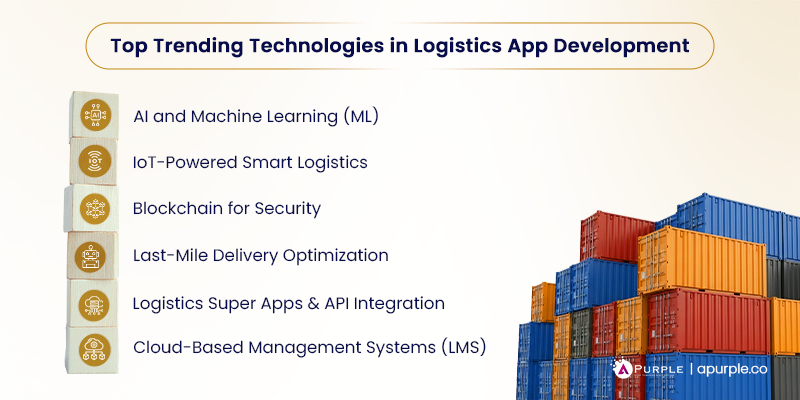
Logistics app development is shifting toward automation and predictive insights. You can plan routes earlier and act before delays hit, and data drives every move.
Trends like AI & LMS in logistics are driving this shift, as they predict demand, delays, and freight flow. You can assign vehicles based on live data and cut idle time and fuel waste.
-
AI and Machine Learning (ML)
AI & ML are used in logistics app development for better route optimization and forecasting. You can reduce the operational cost by integrating AI in logistics. AI-based chatbots also help to improve user support.
-
IoT-Powered Smart Logistics
When you integrate IoT-powered sensors and trackers in logistics app development, it improves shipment visibility. This visibility provides insights into vehicle health, shipment location, and weather for specific types of goods.
-
Blockchain for Security
Implement blockchain to streamline contract execution, ensure tamper-proof records, and enhance security. As a logistics app handles sensitive data, blockchain ensures supply chain transparency and reduces fraud.
-
Last-Mile Delivery Optimization
Apps that provide automated route planning and real-time updates help you give users clear visibility. It reduces the support team’s workload and streamlines delivery.
-
Logistics Super Apps & API Integration
Super apps that build with multiple built-in functions like courier service, freight forwarding, and inventory management. Also, API integration improves the overall logistics workflow with automation and efficiency.
-
Cloud-Based Management Systems (LMS)
If you want access to multiple locations, implement a cloud architecture that reduces infrastructure costs and enables rapid scaling.
Following these trends will help you raise your revenue. You can watch the video to make your business 10 times faster.
What Are Core Challenges and How to Fix Them While Developing a Logistics App?
In the logistics application development process, you may face challenges such as system disconnects, inventory slip-ups, weak security, and compliance issues. Logistics apps handle highly sensitive data, and without strong security, you may face cyberattacks and data breaches.
Here are essential implementations to fix these challenges:
| Challenges | Impact | Solutions |
|---|---|---|
| Lack of real-time visibility and monitoring | These challenges arise from broken communication or from operations that are not visible. A large amount of data depends on manual process and limited tracking creates these challenges. | Implement GPS tracking for real-time updates and a dedicated dashboard. This will involve all parties updated and improving visibility. |
| Route Optimization | Drivers frequently face issues such as traffic and weather-related blockages. It costs you more fuel and time to deliver the consignment. | Automated route optimization in logistic app development updates drivers’ routes according to the traffic and weather for sensitive goods. |
| Data entry management manually | Manual data entry can lead to errors in billing and shipping. If this manual work goes through an unconnected system, you’ll encounter many errors. | Automate your transfers. Consider API or EDI integration during logistics app development. You can also automate the data syncing system in different origins. |
| Inventory tracking issue | Manual tracking of inventory leads to issues such as overstocking and stockouts. This will also affect your revenue. | Automated syncing of inventory data not only reduces the risk of stockout but also helps you with utilizing maximize the space to the maximum. |
How to Build a Logistics App: Step-by-Step Development Process
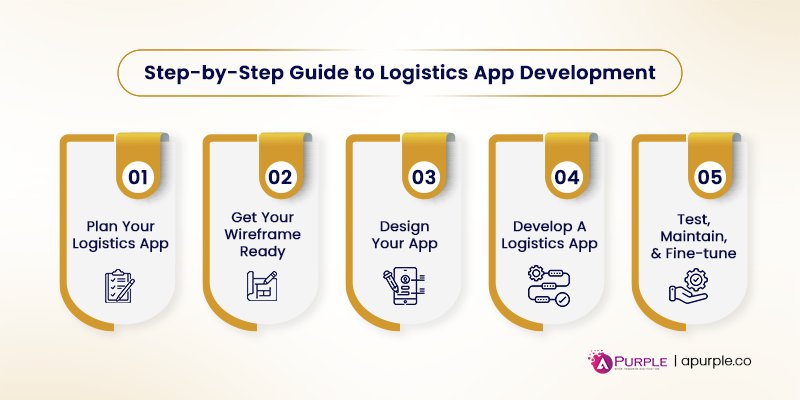
-
Plan Your Logistics App Development
Start by understanding the market and evaluating trends and pain points to help you target a large user base. After that, plan the workflow, features, and how it will resolve logistics operations.
-
Get Your Wireframe Ready
According to the plan, design a wireframe that combines workflow and features. It’s a roadmap with complete resources and timelines. A wireframe gives you a basic idea of the overall cost.
-
Design Your App
A clear roadmap will help you create layouts for your app, but ensure they are intuitive. You have to make it more engaging and easier for drivers, dispatchers, and admins.
-
Develop A Logistics App
Now your app is in the stage where you can see it. Start implementing features for logistics operations and integrate CRM and ERP.
However, you can opt for an MVP development service to validate your idea and scale based on feedback. MVP app development cost is less, so you can market the app on a large scale.
-
Test, Maintain, And Fine-tune
What happens if you complete your logistics app development and a small bug ruins the user’s complete experience? Go for alpha and beta testing, gather feedback, and fix it.
The process is not complete yet. After launch, maintenance ensures the application remains future-ready and works well on new devices
What is the Cost of Logistics App Development?
Logistics app development costs range from 9,500 to 90,000 USD in 2026. This wide range of costs depends on multiple factors, including complexity, platform, and location. A basic MVP will cost you 9,500+ USD, and the cost will increase as you add features and complexity to the app.
| Types of App | App Cost |
|---|---|
| Simple Logistics App | USD 9,500 – USD 20,000+ |
| Medium Logistics App | USD 20,000 – USD 45,000+ |
| Complex Logistics App | USD 45,000 – USD 90,000+ |
Cost Breakdown Based on Phase
| Phase | Cost | Time Duration |
|---|---|---|
| Planning and Analysis | USD 1,500 – USD 5,000+ | 2-4 weeks |
| UI/UX Design | USD 2,000 – USD 7,500+ | 2-4 weeks |
| Frontend Development | USD 4,000 – USD 15,000+ | 4-6 weeks |
| Backend Development | USD 5,000 – USD 18,000+ | 4-6 weeks |
| Android Mobile App | USD 3,500 – USD 12,000+ | 5-8 weeks |
| iOS Mobile App | USD 5,000 – USD 15,000+ | 5-8 weeks |
| Testing & Quality Assurance | USD 2,000 – USD 8,000+ | 2-4 weeks |
| Launch & Support | USD 1,500 – USD 5,000+ | 1-2 weeks |
Why Choose aPurple for Your Logistics Application Development?
We hope this article has offered profound insights into logistics app development. Developing a logistics app is not as easy as it sounds. You need to deal with compliance, data security, and the integration of IoT devices, and a small error can ruin the complete experience of your user base.
A single mistake can cost you your time, money, and company reputation. You can handle this by partnering with an experienced app development company.
As an experienced logistics app development company, we know what makes logistics app development successful. With more than 10 years of experience and 300+ successful projects, our experts are adept at app design & development.
If you want to create an app for logistics operations frequently, aPurple offers several good reasons. Why aPurple is the best choice for a logistics app development partner: we offer.
- Custom development approach
- Cost-focused delivery
- Structured development process
- Ongoing support and maintenance
- User-first design
- Dedicated team of experts
So, if you are looking for reliable logistics app development services, contact us now!
Frequently Asked Questions
Logistics application development means building software that is used for shipment flow and delivery control. You can easily manage orders, routes, drivers, and tracking in one dashboard. Logistics app development includes planning, execution, and monitoring.
The cost of the logistics app ranges from 10,000 to 150,000+ USD, depending on factors such as features and complexity. Basic logistics mobile app development starts with core tracking and dispatch. Advanced systems include AI routing, analytics, and integrations.
Logistics app development improves daily operations. It reduces the delivery time, unnecessary cost, and streamlines the operations with planning.
Key advantages.
- Real-time shipment tracking.
- Lower delivery and fuel costs.
- Faster order processing.
- Better customer updates.
- Data-driven planning and reporting.
A logistics app manages the full delivery lifecycle. A transportation app focuses on vehicle movement.
Logistics app scope –
- Order management.
- Route planning.
- Warehousing and tracking.
- Billing and analytics.
Transportation app scope –
- Vehicle booking.
- Driver tracking.
- Trip status updates.
On-demand logistics app development covers planning and execution. Transportation apps handle movement only.
Logistics mobile app development moves toward AI-driven automation and real-time tracking through IoT devices. AI-driven routing reduces delays, and real-time data improves planning. Integrations with ports, marketplaces, and payment systems grow.
Future focus areas –
- AI-based demand forecasting.
- Smart route optimization.
- Drone and autonomous delivery support.
- Unified dashboards for global logistics.