Updated Date: Jan 29, 2026
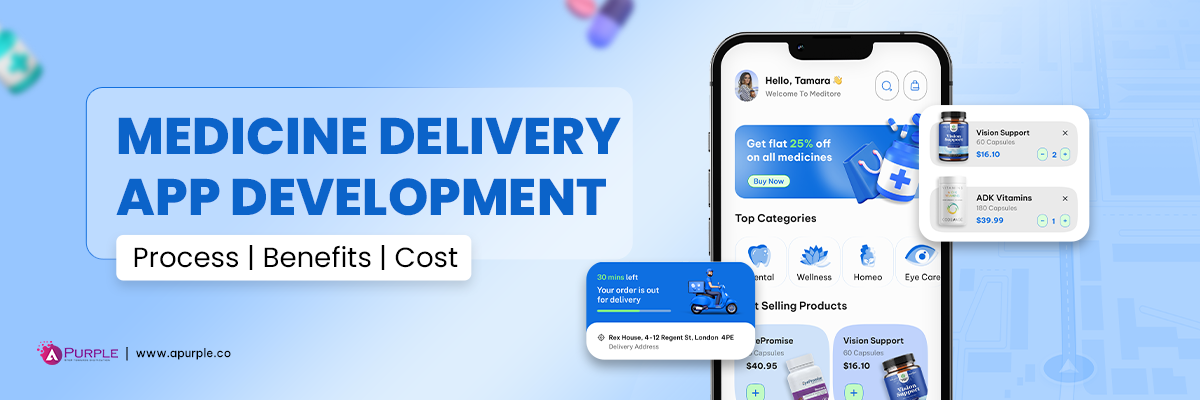
Medicine unavailability is not a hypothetical problem; it’s a daily operational gap across local pharmacies. Stock mismatches, poor visibility, and fragmented supply chains force customers to hunt across stores, while pharmacies lose sales they could have fulfilled. For startup founders, this signals a clear market inefficiency. Just as quick commerce redefined grocery and food delivery, medicine delivery app development offers a chance to digitize availability, enable faster fulfillment, and build a scalable on-demand healthcare platform.
Today’s consumer expects both speed and convenience. That’s where a thoughtfully designed digital solution can become your mini-pharmacy store. It can deliver medicines safely and on time while also staying compliant with HIPAA, FDA, and DEA regulations.
With 10+ years of experience and 200+ healthcare projects delivered to global clientele, we at aPurple know precisely how to craft a winning application. Based on lessons learned from these projects, we have curated this guide to pharmacy delivery app development. It will help you to plan, build, and launch a world-class healthcare solution that grows your business.
What is Medicine Delivery App Development?
Medicine delivery app development is the process of crafting a digital healthcare application that connects end-users with various pharmacies, enabling them to upload prescriptions, order various medicines, make online payments, and have them delivered to their doorsteps based on their time zone. This is especially useful for patients with chronic diseases or who have a medical emergency.
How does a Medicine Delivery App Work?
Before getting into the nitty-gritty of medicine delivery application development, you need to have an idea of how a typical medical delivery works. Here’s the complete breakdown that will help you build one of the top medicine delivery apps.
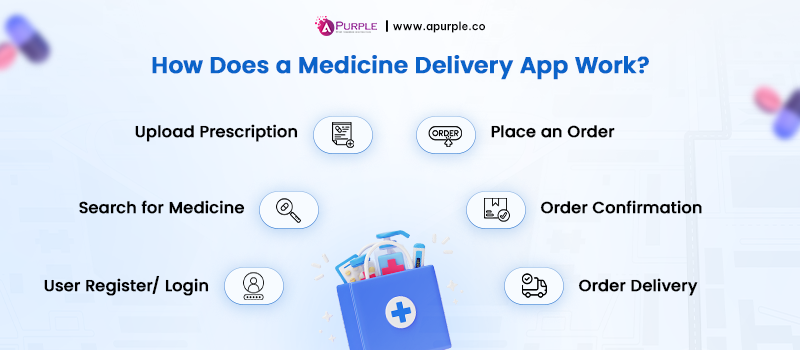
1. Sign-Up & Account Setup
Firstly, the user downloads your medicine delivery app using a phone number or email ID. The user provides basic information such as name, address, date of birth, etc., which helps speed up checkout at the time of payment and also builds trust.
2. Medicine Discovery & Search
Once the account is set up, the user will browse or search for their preferred medicine. When the user selects a specific medicine, the app displays all necessary information, including dosage, usage instructions, side effects, and availability. Having clear-cut instructions upfront reduces the chance of order cancellation.
3. Prescription Upload & Check
After the user finds that their preferred medicine is available for dispatch, they will upload a prescription to the app, if required. The system verifies the prescription details before checkout. It helps you keep your app compliant with local regulations, which are non-negotiable for any healthcare application development.
4. Cart Review & Order Confirmation
After adding the required medicine to the cart, the user reviews the order and delivery details. At the same time, the application confirms the availability of your order with your nearby pharmacies. Once both are verified, the order is confirmed, helping you avoid last-minute cancellations and streamline your checkout experience.
5. Smart Pharmacy Assignment
After the order is confirmed, the app routes it to your nearest pharmacy, with a live stock update. This backend flow is the backbone of your pharmacy delivery app development and ensures speedy delivery.
6. Secure Payment Processing
Here, the user completes the payment process via secure digital payment gateways with multiple layers of security. At this stage, refill reminders are also sent to old users to increase repeat orders, which is an essential feature in on demand medicine delivery app development for driving revenue.
7. Order Pickup & Dispatch
In the final phase of delivery, the pharmacy packs the order for the customer, and the app then assigns a delivery partner. The application coordinates between the pharmacy, the delivery partner, and the user without manual intervention, ensuring a smooth user experience.
8. Live Delivery Tracking
The user can track the delivery in real-time with an accurate ETA (Estimated Time of Arrival). This type of transparency can reduce stress and drop-off rates.
What are the Different Types of Medicine Delivery Apps?
Before you start the development process for a medicine delivery app, you need to be sure about the type of app you need to build. The reason is that each type solves a specific problem, has a particular cost, and determines how quickly you can launch the app to market.
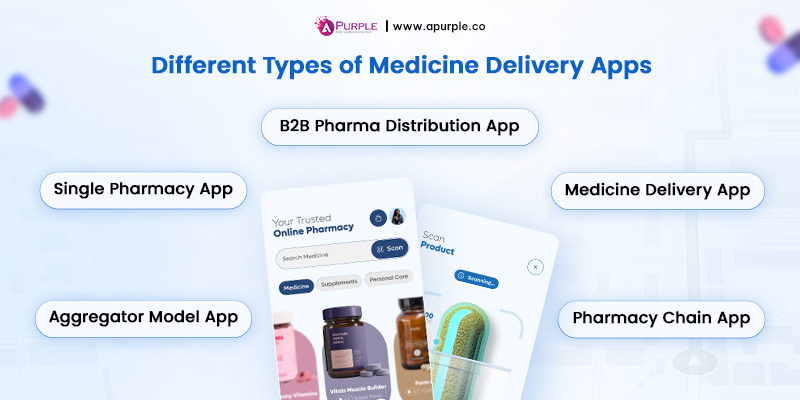
| Category | Description | Best For | Examples |
|---|---|---|---|
| General E-Pharmacies | It provides the user with prescribed medicines, OTC, and wellness products. | Startups that want to scale to a national level | CVS Pharmacy, Walgreens, Amazon Pharmacy |
| Comprehensive Healthcare Platforms | Combine medicine delivery with telehealth, labs, and patient health records. | Startups that want to invest in a full-fledged healthcare system | Practo, MediBuddy, Apollo 24/7 |
| Affordable & Generic-Focused Apps | Focused on providing generic and discounted medicines. | Founders who want to target price-sensitive users | Truemeds, Cost Plus Drugs, GoodRx |
| Subscription & Personalized Kits | Delivers monthly medication packs with pre-sorted packages with auto-reminders. | Startups that want a predictable recurring revenue | PillPack, Care/of, Hims |
| Pharmacy Aggregators | Act as a middleman, connecting users to nearby pharmacies. | Founders who want to validate demand quickly | ScriptDrop, RxLocal, NowRx |
| Niche/Specialized Apps | Focuses on chronic diseases, exceptional cases, and elder patient care. | Founders who want to target niche markets | Truepill, Alto Pharmacy, HealthWarehouse |
What are the Must-Have Features in a Medicine Delivery App?
When you’re looking to build a pharmacy app development solution, the first thing you need to clarify is the feature set that will help you stand out in a highly competitive market.
Here is a list of features according to various user roles (Customers, Pharmacy, Admin, and Drivers) that you should consider for drug delivery app development:
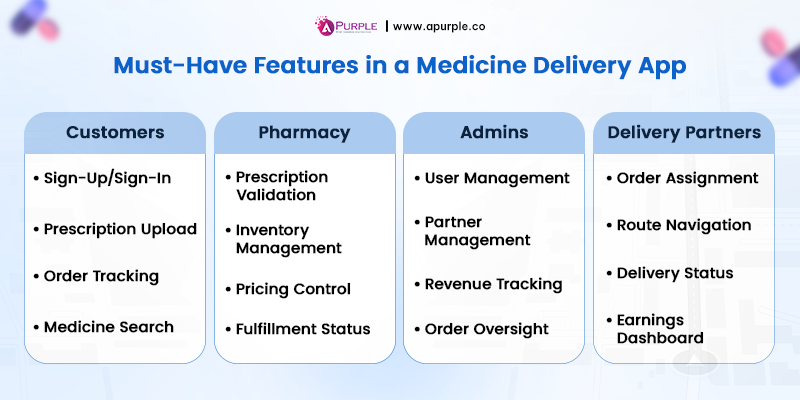
1. Medicine Delivery App Features For Customers
Your end users open your app only when they need a medicine urgently. Therefore, you should incorporate features that remove confusion, streamline ordering, and build trust when opting for on-demand medicine delivery app development.
| Features | What It Does | Why It Matters |
|---|---|---|
| Easy Sign-Up / Sign-In | Enables users to sign up/sign in using a phone number or an email | Allows faster onboarding |
| Prescription Upload | Enables users to scan or upload the medicine prescriptions | Ensures only valid orders are present |
| Medicine Search | Helps users find drugs, dosage, and availability | Reduces drop-off rates |
| Generic Alternatives | Shows alternative medicine when branded products are unavailable | Prevents cart abandonment rate |
| One-Tap Reorder | Allows repeat order in just one click | Drives recurring revenue channel |
| Real-Time Tracking | Displays delivery status in real-time | Reduces anxiety among users |
| Secure Payments | Support for credit cards and digital payments | Improves checkout success |
| Alerts & Reminders | Sends real-time order updates and refill reminders | Keep end-users engaged |
| In-App Support | Provides help for common issues. | Prevents churn during urgent updates |
2. Medicine Delivery App Features For Pharmacy
The pharmacy shop wants to improve operational efficiency. These features will help them to process more orders, streamline operations, and set them up for future growth.
| Features | What It Does | Why It Matters |
|---|---|---|
| Order Dashboard | Displays all incoming and active orders | Keeps your fulfillment organized |
| Prescription Validation | Verifies details before approval | Reduces compliance issues |
| Inventory Management | Synchronizes medicine stock in real-time | Reduces cancellations and delays |
| Substitute Suggestions | Enables the pharmacy store to suggest alternatives | Improves fulfillment rate |
| Pricing Control | Allows pharmacies to set prices and discount offers | Protects pharmacy store margins |
| Customer Messaging | Allows direct communication with end users | Reduces order errors |
| Order History | Provides all the history of previous orders | Enables reviews and audits |
| Fulfillment Status | Updates the stages of order preparation | Enhances delivery coordination |
| Business Insights | Displays sales and order trends | Helps pharmacy stores plan better |
3. Medicine Delivery App Features For Admin
As a founder or product owner, this is your command-and-control centre. These features will help you gain visibility into revenue, user base, compliance, and more.
| Features | What It Does | Why It Matters |
|---|---|---|
| User Management | Control the access for drivers, customers, and pharmacies | Keeps your platform secure |
| Order Oversight | Tracks all the orders in real-time | Enables faster resolution of any query |
| Revenue Tracking | Display the commission and payout for all time | Allows proper financial planning |
| Compliance Controls | Monitor medicine prescriptions and data handling | Reduces legal issues |
| Dispute Resolution | Handles refunds and complaints | Protect the brand’s trust and reputation |
| Partner Management | Onboarding and management of pharmacy stores | Supports business growth |
| Location & Zone Setup | Defines the delivery and service areas | Uplifts logistics efficiency |
| Platform Rules | Configures workflows and fees | Allows quick iteration |
| Performance Reports | Tracks various operational metrics | Enables smarter decision-making |
4. Medicine Delivery App Features For Drivers/Delivery Partners
Delivering the product to the destination is the final step. Here is a list of features that help drivers or delivery partners deliver medicines accurately, reduce failed deliveries, and address customer support issues.
| Features | What It Does | Why It Matters |
|---|---|---|
| Order Assignment | Assign deliveries to the driver based on proximity | Improves the speed of medicine delivery |
| Route Navigation | Optimizes the delivery routes | Reduces delays in delivery |
| Delivery Status | Provide updates on drop-offs and pick-ups | Keeps the customers informed |
| Proof of Delivery | Captures a photo or a signature | Prevents any disputes |
| Customer Contact | Enable call or message when required | Avoid delivery failure |
| Earnings Dashboard | Shows completed orders and payments | Improve driver retention rate |
| Availability Toggle | Allows the driver to be available or unavailable | Adds flexibility for drivers |
| Issue Reporting | Enable drivers to flag any issues | Reduces escalation time |
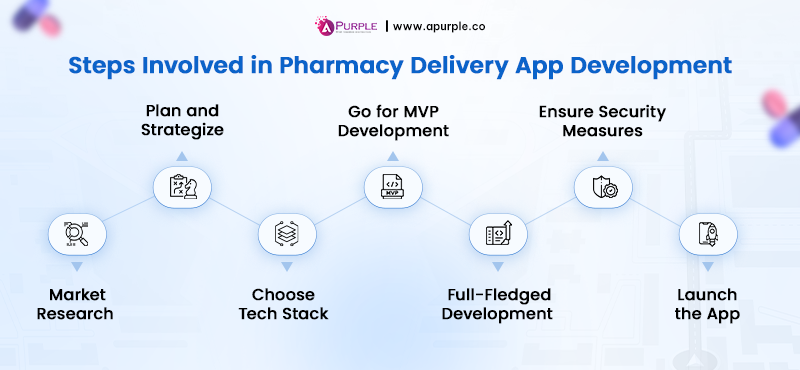
What are the Steps Involved in Pharmacy Delivery App Development?
When you’re building a medicine delivery app, you’re more concerned as a founder about making the wrong decisions, and that too early on, rather than just the speed of the development process.
To address that issue, we have prepared an executive-level decision-making table for founders that will help you understand what the most important thing is at a particular stage, what you can do wrong, and what a brilliant startup founder would do.
| Step | Critical Decision To Make | Common Founder Mistake | Smart Founder Decision |
|---|---|---|---|
| Market Research | For whom are you building the app, and what is the purpose of that | Targeting “Everyone” | Focus on users who can give you repeated orders |
| Plan & Strategize | What to keep in the MVP vs what to keep for later phases | Treating roadmap as a “feature list.” | Define those flows that are needed for market validation |
| Choosing Tech Stack | Which tech to invest in for long-term results | Over-engineering or running behind every new tech | Use proven and HIPAA-compliant technologies |
| Build an MVP | What does success mean in version 1 | Building just a demo instead of a usable product | MVP must process real orders |
| Develop Full-Fledged App | Plan for scaling and long-term features | Scaling the features before operations are stable | Automate workflows & improve system reliability |
| Security & Compliance | Plan to handle compliance | Treating compliance as just legal paperwork | Taking compliance standards into account for product design |
| Launch, Monitor & Maintain | What drives growth after the launch | Relying on marketing to cover technical flows | Fix operation chaos before scaling the product |
Now, let’s break down various steps in detail.
Step 1: Carry Out Market Research
Before getting into any development details, you need to understand the market for which you’re developing your product and the purpose of building it. That’s where conducting market research is essential, as it gives you an idea about your target audience.
You should focus on:
- Users who regularly order medicines and are not on them once in a while
- Day-to-day business operations’ pain point, and not on UI complaints
- “Bare minimum” that the user considers for any healthcare apps
Having this clarity upfront lays strong foundations for online pharmacy app development, driving loyalty and engagement.
Expert Tip: If you’re not able to create a niche audience after research, you’re not sure about your target market.
Step 2: Plan & Strategize the App
Planning is the most critical stage for stopping burn rate on your product.
Focus on answering questions like:
- What must be done to place a legal medicine delivery order?
- How can we reduce manual handling early?
- What are things that don’t require validation?
For example, if virtual consultations are part of your long-term plan, you must plan for telemedicine app development at the architectural level.
Strong planning means you have set boundaries for MVP, very few rebuilds, and predictable timelines.
Expert Tip: A good strategy in the initial stages limits your scope and narrows your focus on delivering a quality product.
Step 3: Choose the Tech Stack
Your tech stack is a pillar on which you can build a world-class medicine delivery app that adapts quickly to changes, is reliable, and compliant. If you opt for tech just because it’s flashy, new, and trendy, it can cost you in terms of speed.
Here’s how you can pick the ideal tech stack for your medicine delivery mobile app development:
| Layer | What You’re Deciding | What To Prioritize | Startup-Safe Options |
|---|---|---|---|
| Frontend | Time-to-Market | Cross-Platform Delivery | React, Angular, React Native, Flutter, Vue.js, Swift, Kotlin |
| Backend | Ease of Change | Modular Code | Node.js, Python, Java, Django, Spring Boot, Ruby on Rails |
| Database | Data Security & Scale | Proven & Secure Storage | PostgreSQL, MySQL, MongoDB, Cassandra, Firebase |
| Cloud | Compliance Readiness | HIPAA-Compliant Infrastructure | AWS, Google Cloud, Microsoft Azure |
| Payments | User Trust | Universally Accepted Payment Gateways | Braintree, PayPal, Apple Pay, Google Pay, Stripe |
| Security | Data Protection & Access | Built-In, Not Bolted-On | OAuth 2.0, SSL, AES, PCI DSS, GDPR, KYC, AML |
Expert Tip: Choose a technology stack that your product team can sustain under pressure, not the one that looks impressive.
Step 4: Build an MVP
Your MVP must answer one question: Will users trust your product to place an order?
- If the answer is YES, you have got your product-market fit.
- If NOT, then you may need to realign your thoughts.
The MVP you build must have these functionalities:
- Secure onboarding of users
- Prescription upload facility
- Order placement & seamless payment
- Order visibility & tracking
If you’re still confused about how to MVP properly, leverage our MVP development services to build an MVP that is clean, lean, and validates your market demand.
This phase will reveal whether users trust you for online medicine delivery app development based on the drop-off rate.
Expert Tip: If your real users can’t place medicine orders seamlessly, your MVP isn’t ready.
Step 5: Develop a Full-Fledged App
After successfully launching an MVP in the market, if your users are reordering medicines without any reminders, it means the app is ready for scale.
This phase focuses on:
- Performance and uptime
- Workflow automation
- Refill and reminder features
- Admin panel efficiency
Here, you can also add additional workflows. For example, if you want to create a workflow to integrate medical apps for doctors to improve prescription turnaround, you can do so.
By the end of this phase, your medicine doorstep delivery app development will result in an operationally scalable product ready to support growth.
Expert Tip: Focus on scaling operations first before adding advanced-level features
Step 6: Ensure Security & Compliance
If you’re dealing with online pharmacy app development, you need to abide by the strict regulations and laws, as even a small legal failure can shut your app down permanently.
While devising every workflow, you must keep in mind:
- HIPAA – compliant handling of medicine and user data
- Encryption of data in transit and at rest
- Role-based access control to limit system access
- DEA – compliant workflows for controlled substance prescriptions
- Audit-ready system logs to support FDA – aligned traceability
Expert Tip: Achieving compliance is cheaper when it’s part of the development process rather than an afterthought.
Step 7: Launch, Monitor & Maintain
Once your app is ready and complies with all requirements, launch it in the market and monitor its performance. To track the success of your online medicine delivery app development, you can monitor metrics such as:
- Success rate of your orders
- Failure rate of your medicine deliveries
- Number of tickets raised in customer support
- Repeated order ratio
Expert Tip: A product launch is never the finish line but a little milestone. You should continuously monitor the app to improve it and make it world-class.
What are the Key Challenges in Pharma Distribution App Development?
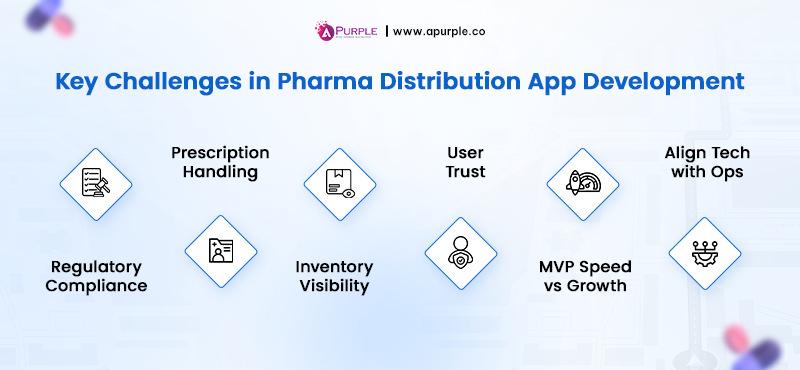
Building a world-class medicine delivery app has challenges beyond design and development. Here are the key roadblocks that you may encounter while building such an application:
1. Regulatory Compliance Across Global Markets
If you’re someone in the healthcare industry, you must know that healthcare regulations vary by country, state, and sometimes even city. Data privacy, secure prescription handling, and medicine distribution laws vary by location.
The Impact:
Even the most minor compliance gaps can delay your product launch, limit future business expansion, and require costly changes after development.
Pro Tip: When opting for an online pharmacy app development, treat compliance as a requirement, not a legal procedure. It will help you to build a compliant app from the beginning.
2. Seamless Handling Of Prescription
How easily a user can upload a prescription and how quickly your app can validate it defines your core user experience.
The Impact:
Too many steps for prescription upload or validation can frustrate your users.
Pro Tip: A good pharmacy app development solution combines automation with manual review. Always start with a simple flow and optimize it based on real-time feedback.
3. Inventory Visibility & Order Fulfillment
When a user visits your medicine delivery app, they want their desired medication to be available.
The Impact:
Out-of-stock medicines, partial orders, and delayed deliveries can cost you in terms of user loyalty and repeat purchases.
Pro Tip: Inventory synchronization should be a core part of your medicine ordering app development. Real-time availability and alternative options can increase user loyalty.
4. Building Trust With New Users
Healthcare users are cautious by nature, and so, they want clarity before convenience in your medicine delivery application.
The Impact:
If the app is not easy to use or lacks clarity about the ordering and data storage processes, it will result in a higher drop-off rate.
Pro Tip: You should emphasize transparency, i.e., transparent pricing, verified pharmacy stores, visible order status, etc., while dealing with mobile app development for pharmacy.
5. Balancing MVP Speed With Long-Term Growth
Many startup founders make the mistake of solving every problem in the first version itself.
The Impact:
An overbuilt MVP can delay your market entry, increase cash burn, and cause you to miss product-market fit.
Pro Tip: Define a narrow scope for your MVP, solve one burning problem, validate those requirements in the market, and then expand features.
6. Aligning Technology With Core Operations
The success of your application depends on pharmacy stores, delivery partners, and the customer support team working in synchronization.
The Impact:
Poor coordination here can lead to broken workflow and operational chaos.
Pro Tip: Focus on designing the workflow and UI/UX first. Once your operations are in order, scaling becomes much easier
How Much Does it Cost to Build a Medicine Delivery App?
The approximate cost to build a medicine delivery app for startups can range from USD 9,500 to USD 90,000+.
However, if you break down the medicine delivery app development cost, you will realize that the final figure depends on several factors, such as:
- The type of application complexity (MVP, Simple, Complex, or Advanced)
- The technology stack that you choose for development
- The location of the development team you opt for
- The development approach (Native, Hybrid, or Cross-Platform)
- The type of features required for the application
- The security and compliance requirements
To give you a rough idea of pharmacy app development cost, here’s a table that shows the costing figures based on the application complexity (MVP, Simple, Complex, or Advanced):
| Type of App | Development Cost | Development Time |
|---|---|---|
| MVP App | USD 9,500 to USD 18,000+ | 2 to 4 months |
| Simple App | USD 20,000 to USD 25,000+ | 3 to 6 months |
| Complex App | USD 25,000 to USD 40,000+ | 6 to 10 months |
| Advanced App | USD 40,000 to USD 90,000+ | 8 to 12 months |
Note: The final cost may vary depending on individual requirements and several factors. Partner with us to get a rough estimate of the MVP development cost that helps you prepare for the first phase of the product launch.
Which Business Model Works Best for Pharmacy Delivery Apps?
Your business model plays a vital role in determining whether your business will scale seamlessly and reach the next level or burn cash. If you pick the wrong business model, even the most potent online medicine delivery app development can’t save you from thin margins.
Here are the popular business models for online pharmacy app development:
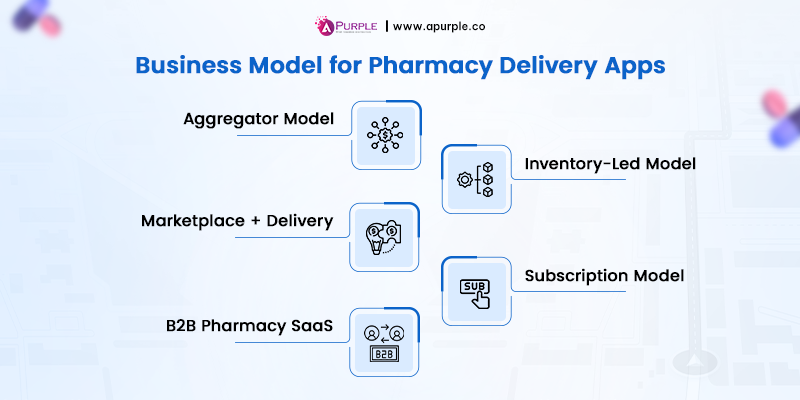
| Business Model | How It Works | Pros | Cons |
|---|---|---|---|
| Aggregator Model | Connects users with nearby pharmacy stores and earns per order | Inventory risk is low, Product launch is faster, MVP validation is quicker | Low profit margin |
| Inventory-Led Model | Here, you are in control of inventory, fulfillment, and pricing | Complete control over proceedings, Higher profit margin | High capital and licensing costs, High operational complexity |
| Marketplace + Delivery | Here, the pharmacy store lists products, and you manage the logistics part | Strong value proposition, Recurring revenue | Delivery operations can get expensive at times |
| Subscription Model | User pays a fixed amount for monthly refills | Predictable revenue, High user retention ratio | Requires strong user trust and compliance |
| B2B Pharmacy SaaS | You sell the technology to various pharmacy stores | Scalable model, Steady cash flow | Longer sales cycles |
How does the Medicine Delivery App Make Money?
Before building a pharmacy app development solution, you need to be clear about how your app will make money. If you don’t have clarity on a monetization model, a well-built app can struggle to scale, attract investors, and move beyond the MVP stage.
Here are the popular monetization models for a medicine delivery application:
| Monetization Model | How It Works | Best For |
|---|---|---|
| Commission Per Order | You take a percentage from the pharmacy store on every order | Early-stage startups that want to validate demand |
| Delivery Fee | Users pay a delivery charge based on location | Markets that have a higher order frequency |
| Subscription Plans | Users pay a monthly fee for a refill and free delivery | Startups that deal with chronic care medicines |
| Pharmacy Onboarding Fee | Pharmacies pay to list their medicine and access platform features | Founder-led platforms targeting a local audience |
| Feature Listing & Ads | Pharmacy stores pay for higher visibility in search results | Highly competitive urban markets |
| B2B SaaS Licensing | Monthly charges to use your pharmacy software | Founders who want to avoid heavy logistics and compliance fees |
What are the Latest Trends in Online Medicine Ordering App Development?
You’re not just building a basic app. You’re building a medicine delivery app, and so, you’re competing against established brands, strict compliance rules, and cautious users. That’s why knowing the latest market trends is essential.
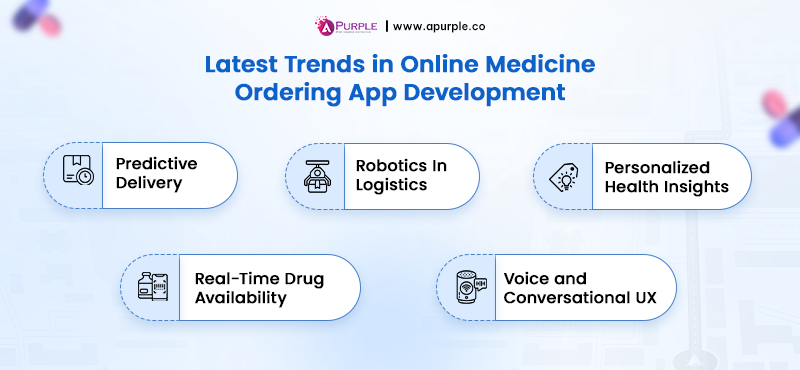
| Trends | Why It Matters |
|---|---|
| Predictive Delivery | Apps will use AI to anticipate medical demand, reducing drop-off rates and increasing user loyalty. |
| Voice & Conversational UX | Users will be able to reorder via voice or text, improving the user experience and accessibility. |
| Robotics In Logistics | Delivery bots and autonomous vehicles will speed up delivery and reduce logistics costs. |
| Real-Time Drug Availability | Live inventory visibility means fewer order failures and higher user satisfaction. |
| Personalized Health Insights | The user will receive personalized health insights based on their order history. |
Why Choose aPurple for Medicine Delivery App Development?
Developing a medicine delivery app is not as easy as it sounds. You need to deal with prescriptions, strict healthcare regulations and compliance, data privacy, real-time logistics, and no room for failure.
A single wrong decision in this type of scenario can cost you time, money, and brand reputation. That’s where you need an experienced partner with knowledge of profitable on-demand app ideas and experience in handling many healthcare projects.
With 10+ years of experience and 100+ on-demand apps delivered with distinction, aPurple, a top-rated on-demand app development company, can be your ideal partner for medicine delivery app development. Here’s what you get by partnering with aPurple:
- Lean and clean MVP to launch and validate your product faster in the market
- Startup-focused development cost and timeline for clarity and transparency
- Compliant-aware product without overengineering
- Feature prioritization that saves you from burning your cash
Are you ready to turn your idea into a secure, scalable, and compliant medicine delivery app? Talk to our experts and get a clear roadmap to build a winning product.
Frequently Asked Questions
- Users download the app, register themselves, and search for medicines.
- Users add medicines to the cart, choose delivery preferences, and place the order.
- The app confirms stock availability with nearby pharmacies, confirms the order, and notifies the user.
- A delivery partner picks up the order and delivers it to the user’s doorstep.