Updated Date: Feb 12, 2026
Over the years, the business model of Lyft has been transformed from growth-at-all-costs to profitable and monetization-focused, along with efficiency. So, it has been worked to gain the loyalty and trust of end users (both drivers and riders) with a seamless experience. For entrepreneurs & business enthusiasts strategizing the on-demand business model, Lyft is a good example. This blog stands as a relevant source during your research, so read till the end!
What are the Main Components of the Lyft Business Model?
Lyft has started with the vision of a community-driven rides partner and evolved to the on-demand taxi app solution across the USA and Canada. The Lyft marketing strategy was beyond imagination and has completely nailed the online ridesharing space. It has been dealing with both B2B and B2C customer segments. Get the insights on each of these now!
Lyft Business Model [B2B] Segment
Lyft Business Profile:
It enables employees to separate business from personal rides. They can keep a record of their transportation for business purposes separately and automate expense management.
Lyft Pass:
The companies provide Lyft ride credits to its clients or employees. So, they give them a pass as a commutation cost directly billed to the business.
Lyft Concierge:
This offers business organizations, such as hospitals and hotels, the ability to book rides on behalf of clients or passengers. It works as the added perk of pick-up and drop-off service for their customers.
Lyft Healthcare:
It provides transportation solutions to patients and non-emergency medical transportation (NEMT). So, Lyft has built a network of medicare organizations and supports the patients’ quick transportation.
Lyft Business Model [B2C] Segment
On-Demand Booking for Rides:
The main B2C service offering is harnessing users to book rides smoothly using the app/site. It emerges as the on-demand app solution for taxi or ride booking
Car Rental Services:
Lyft even provides drivers with a car on a rental basis. It is designed for drivers who don’t have a vehicle.
Aside from that, the pink moustache played a crucial role in defining the success of Lyft. So, it has started working in a completely new way for a ride-sharing service. Besides that, Lyft’s business rewards for drivers are a proficient way to keep the drivers happy with their job. To keep it straightforward, here’s the Lyft business model analysis.
Lyft Business Model Canvas
The picture has a clear portrayal of the nine building blocks of the business model canvas (BMC). It will help you in determining Lyft’s overall business goal.
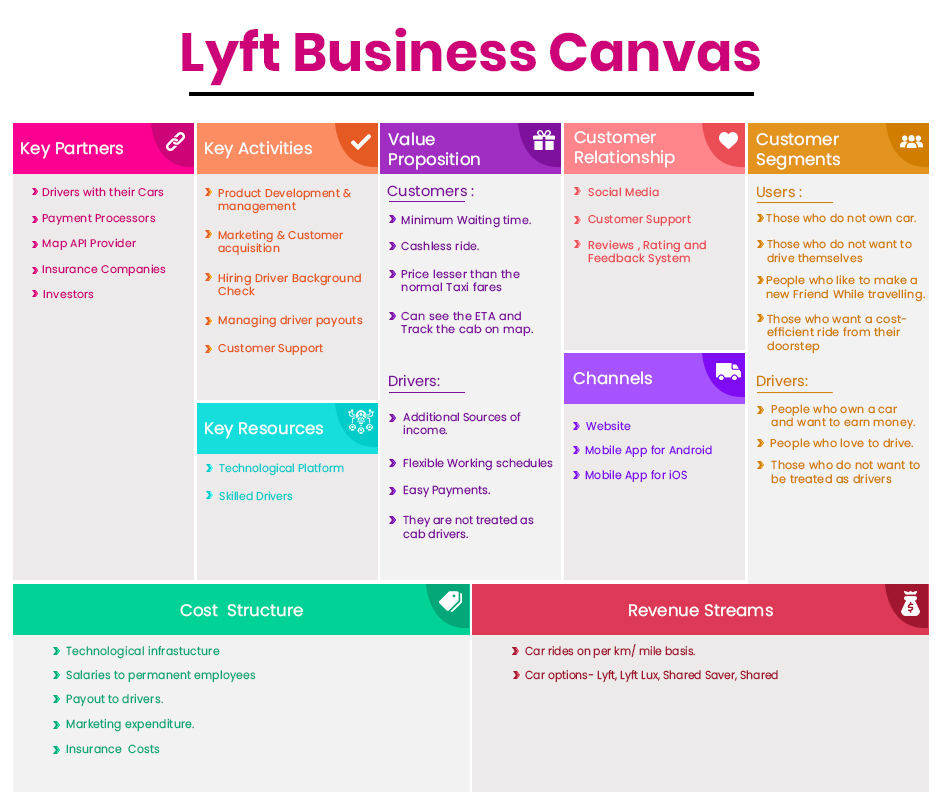
Lyft, being the leading online taxi solution, has been expanding its horizon beyond the traditional ride-hailing app. Now, Lyft is working exponentially great in the following areas as well;
- Food & Daily Essential Delivery
- Bike & Scooter Sharing
- Healthcare & Medical Transportation
- Corporate/Employee Travelling
Moreover, Lyft has literally lifted its offering to reach a vast audience and tap into the local audience seamlessly. You can make an overall growth impact by strategizing your app like Lyft. It’s quite a great inspiration for aspiring startups.
How Does Lyft Work – Driver & Rider Panels Explained
Lyft is a carpooling and transportation marketplace that aggregates riders with drivers. It has two panels, i.e., rider (passenger) and driver. The online website or app operates in sync based on the requests of riders and received by drivers.
Basically, the Lyft riders can search for a nearby taxi through their app and book a ride for commuting from Point A to B. Lyft riders can select from the pool of different modes like Lyft (Standard), Lyft XL, Lyft SUV, and Lyft Black. On the other side, the Lyft driver gets a notification when a user books a cab. According to availability, the nearby drivers can accept or decline the ride. Riders can oversee and select the drivers with genuine ratings and reviews.
Therefore, this aggregator model allows the rider to track, rate, and pay the driver through the app. So, Lyft has kept it very simple for both panels. Here’s the proper breakdown of Lyft workability for drivers and riders, respectively.
How Does Lyft Work For the Driver?
The driver panel of Lyft works as follows;
- To register as a reliable driver on Lyft, you must share and verify your personal information. Name, age, background check, valid driver’s license, etc., need to be validated.
- With assurance of guaranteed earnings for each ride accepted, the driver gets better interaction.
- Drivers are notified of the nearby riders’ request to book their taxi. It has the live location, fare, time, and destination of the ride.
- Hence, they can accept or reject the ride according to their convenience.
- After completing each ride, the rider makes payment either in cash, card, or online mode.
- Divers often get tipped well by the riders. Such benefits are highly into the car rental services for long journeys.
How Does Lyft Work For Riders?
The riders can utilize Lyft for taxi and bike ride booking in the following way.
- Users can create their profile as a rider (passenger) with name, contact number, and location details.
- Whenever users want to reach somewhere with a taxi, they (riders) can mention the location and browse the nearby taxi/bike/scooter on Lyft.
- Based on preferred car type and fares, you can select and book the ride.
- Further, whoever the driver accepts the location of the rider, reaches their destination on the given time.
- The driver picks the rider and asks for the PIN verification. Accordingly, the idea begins at the destination.
- Once the driver drops the riders, they make payment in the predefined mode. Further riders also see the option to rate the ride or driver experience.
So, the majority of the audience is familiar with the Lyft workflow. Now, taking you to the interesting part of the Lyft business model and the scope.
What is the Value Proposition of Lyft? (For Drivers & Riders)
Every business can thrive in the competitive market by addressing the problems of its stakeholders. Like other ride-sharing business models, Lyft’s stakeholders are riders and Lyft drivers.
Lyft’s business model emphasizes solving the commuting problem that occurs in the daily lives of people. It does that in a way that benefits not only cab users but the drivers as well. Let’s check out the target market of Lyft.
How Does Lyft Provide Value to Customers?
Lyft’s tagline, “ Find a New Friend Everyday” completely justified the rider’s emotion. It feels more comfortable and safe with the Lyft drivers. Comparatively lower fares than traditional cab rides. So, there are ride options for customers’ every need:
- Lyft standard, Shared, Shared saver for economical rides (Limited to Certain Cities)
- Lyft Lux and Lux Black for comfortable and luxurious rides
- Lux XL and Lux Black XL for accommodating more riders
People with accessibility needs can book a ride with a wheelchair, too. Under passenger perks and rewards programs, users can earn free rides or some credits. It is beneficial for both the referred rider and the referring rider. Moreover, the in-app payments make it easy for customers to pay the fare from the app, so there is no need to worry about cash payment or changing problems.
How Does Lyft Provide Value to Drivers?
Drivers are an inseparable part of top ridesharing apps and companies. They are the heart of the rideshare business. So, to have an ideal business model that enforces drivers’ trust is necessary. With attractive rewards and perks, drivers would love to drive for a company that offers flexibility and freedom. Lyft has also introduced new benefits and rewards for drivers. Here’s how Lyft adds value to the driver’s life.
- Those who love to drive could make new friends on their rides.
- A flexible working model lets drivers work at their convenience.
- The faster payment system attracts more drivers to work with Lyft.
- Apart from the trip the driver takes, they could also earn tips and bonuses for going the extra mile.
Lyft helps its drivers to earn more by suggesting areas where they could get more customers. On top of it, the company provides an insurance policy for drivers that covers liability, injuries, and other damages to the vehicle. Now, moving to the income/revenue generation model of Lyft. It will show how this masterstroke value proposition has opened a better ROI opportunity.
How Does Lyft Make Money – Revenue Model
Lyft has the optimal money-making approach. The following picture shows the recent revenue figures.
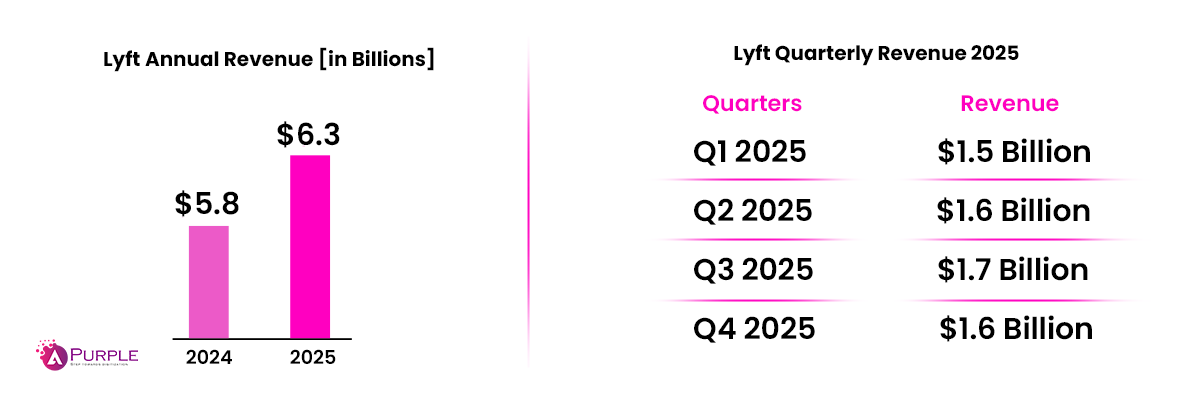
The full-year revenue of 2025 has reached $6.3 billion with a net income share of $ 2.8 billion. It is significantly higher than $22.8 million in 2024. As a result, the Lyft 2025 revenue report showcases an increasing trend with better net income. So, it earns from the following sources.
1. Ride-Hailing Commissions
The ride-hailing commission is the most obvious way of earning money for Lyft. It takes around 15 to 30% of the total fare. So, fare paid to the driver has prespecified share divisions between the driver and the Lyft business.
2. In-App Advertisement
Lyft’s business model includes the earning source through in-app advertising. Lyft has brand collaborations and sponsored ads running on the website and app. It is a great source of return and increases the long-form partnerships with brands.
3. “Lyft Pink” Subscription
Lyft Pink’s subscription model is a membership program that allows users to get exclusive perks. Free priority pickups, unlimited bike rides, and many other benefits are available to Lyft Pink members. Hence, it unlocks as a lucrative income generation solution.
4. Dynamic Surge Pricing
This is an added income way, during the peak or rush hours, Lyft charges a higher per-ride cost. So, it automatically turns into a better return source on each ride.
5. Booking Fees
There is a dedicated fixed booking fee included in each ride. It acts as the constant income flow for the Lyft business.
6. Express Drive Program
Next is the Lyft Express Drive Program, which works as the rental-based revenue mode. It connects drivers who look for vehicles to collaborate with companies. So, it provides vehicles on a rental basis and deducts the rental cost from the drivers’ earnings directly.
7. Corporate Partnerships
It’s the B2B revenue model that earns on offering a tailored transportation solution to the enterprise ride partner. Basically, the enterprise gives perks to employees for commuting to work more simply.
While Lyft has left no stone unturned, when it comes to revenue streams. Still, it is most debated or compared with Uber. So, it is essential to clearly portray both of them in the frame.
What is the Major Difference Between the Business Models of Lyft & Uber?
| Uber | Lyft |
|---|---|
| Uber operates in diverse global regions of about 70+ countries, targeting to the wider audience | Lyft focuses primarily on the USA & Canada and works on a streamlined ride-sharing solution |
| Uber has grasped multiple service offering models through Uber Eats, Uber Health, and Uber Freight. So, it captures different industry horizons. | While Lyft has remained a single and centralized focus as a ride-hailing model & car rental service (Flexidrive) |
| By extending the services to multiple facets, Uber is undoubtedly dominant and gained customer loyalty | Although Lyft has kept a long-term profitable strategy, it is somewhat limited to its geographical scope. |
Well, this is just a comparison between the business models of Lyft and Uber. For a detailed guide, you can refer to the blog on Uber Vs. Lyft.
Growth Strategy & Future Prospects of Lyft
When having the right business model for a ride-hailing app like Lyft, you should focus on the monetizing metrics. You can make the solution readily with an end-user perspective business model. For example, autonomous vehicles (AVs) are the future-driven solution. It makes Lyft’s business model inclined to the masterstroke strategy.
Moreover, with the expansion to the B2B corporate partnerships, Lyft has gained more exposure to the potential collaboration across regions other than the US. So, you can expect a sustainable but scalable growth shift with AVs integration ahead!
FAQs
Lyft is more of a community-driven ride-sharing solution. While Uber has extended its boundaries and reached diverse service offerings, Lyft has mainly stuck to the basics. So, it has certainly emerged as the restriction of Lyft to the USA exclusively.
To begin with, developing a ridesharing app like Lyft, you need to allocate around $10,000. It will help you in MVP development as a ridesharing solution.
Yes! It is more focused to scale in the competitive market by expanding operational efficiency and driving strategic partnerships. As Lyft is eyeing autonomous vehicles, it will have great growth expectations further.