Updated Date: Feb 6, 2026
A US food delivery startup founder once told us, “Delivery orders were growing every month, but there was no increase in profit margin.” So, on paper, the business looks fantastic, but in reality, it’s far from it, with rising platform fees and paid promotions taking a significant share of profit margins.
This is a reality of many food delivery startups, cloud kitchens, and restaurants worldwide. When you list your restaurant on a food delivery platform, it feels like growth, with increased visibility and demand. However, when you analyze the platform’s commission fees and paid promotion charges, most of your profit margin is lost.
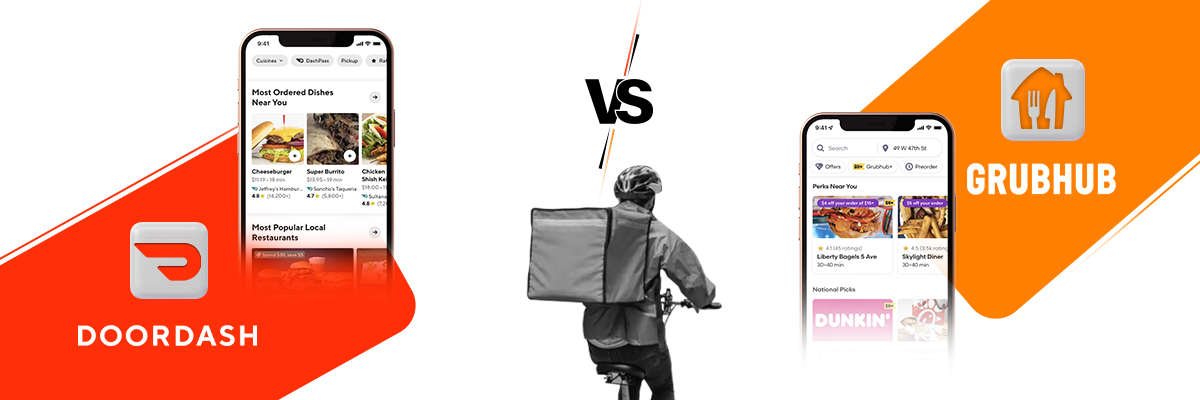
In this scenario, choosing the right food delivery platform can be tricky. Usually, founders tend to pick either DoorDash or Grubhub as they’re both popular. However, the DoorDash vs Grubhub decision can’t be taken on surface-level metrics like the number of orders or current market share. Both platforms can help you reach US customers, but they differ in pricing, customer behaviour, and operations.
To help you out, we have written a parameters-based comparison guide, drawing on firsthand experience, to help founders like you make informed decisions about Grubhub vs DoorDash based on your business requirements.
DoorDash vs Grubhub: The Comparative Analysis
Before moving on to the detailed parameter-based comparison between DoorDash and Grubhub, let us do a quick Grubhub vs DoorDash comparison to help you understand which platform will deliver the best ROI for your business.
| Metric | DoorDash | Grubhub |
|---|---|---|
| Founded | 2013 | 2004 |
| Market Share (2026) | 67-68% in the US food delivery industry | 8% in the US food delivery industry |
| Coverage | 7000+ cities | 1600+ cities |
| Restaurant Partners | 450,000-500,000+ | 115,000+ |
| Delivery Time | 35-40 mins | 40-45 mins |
| Subscription | DashPass | Grubhub+ |
| Fees | USD 1.99–USD 7.99 delivery charge + 10–15% service charge | USD 2–USD 8 delivery charge + 5% service charge |
| Real-Time Tracking | Yes (GPS) | Yes |
| Promotions | Frequent, aggressive deals | Loyalty-driven, occasional |
| Driver Network | 7M+ Dashers | Smaller, urban-skewed |
DoorDash vs Grubhub: A Brief Overview
When startup founders compare Grubhub and DoorDash, they want to know the number of orders, profit margins, delivery speeds, administrative control, and the mix of short-term orders versus long-term revenue.
Let’s give you a brief overview of both platforms to help you get a basic understanding.
What is DoorDash?
DoorDash is the largest food delivery platform in the United States. It helps end users connect with various restaurants, retailers, and grocery stores, providing convenience, speed, and visibility through a massive network.
Benefits of DoorDash for startups:
- Large customer base
- Higher number of orders
- Faster delivery times
- Stronger brand trust
- Increases order frequency
- Early traction
- Reliable logistics
What is Grubhub?
Grubhub is a food ordering and delivery marketplace with a massive name in local markets. Acquired by the Wonder Group in 2025, Grubhub focuses on order transparency, steady profit margins, and a robust distribution network in select areas.
Benefits of Grubhub for startups:
- Transparent refund policy
- Strong profit margins in local areas
- Lower order volume
- Pickup-friendly model
- Less discounting pressure
- Predictable performance
DoorDash vs Grubhub: A Market Overview
If you’re someone running a food delivery business in the United States, then you need insights about the US market size, share, projected revenue, and stuff like that.
So, let’s do a market overview of DoorDash vs. Grubhub to help you understand the potential market size or revenue you can tap into by choosing one platform over the other.
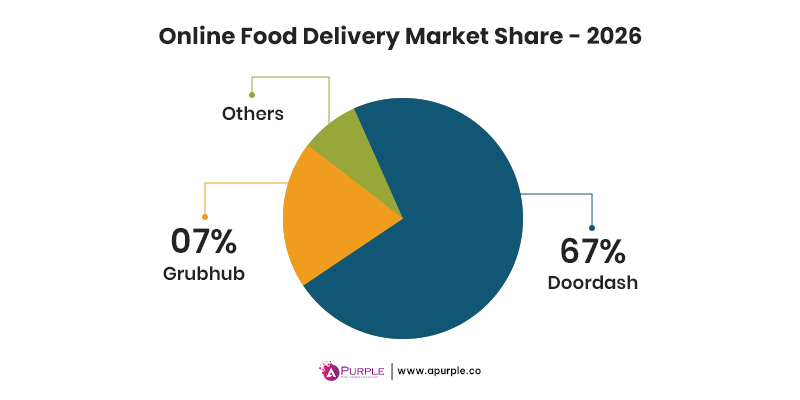
The online food delivery market revenue is expected to grow to USD 93 billion, while the size is expected to become USD 74.03 billion by 2030.
In this massive market, DoorDash remains dominant in 2026, with a 67% market share, while Grubhub has only 7%.
Dominance can help you gain more orders and acquire more loyal customers, but it’s not an indicator of higher profitability.
In addition, according to the latest available data, DoorDash’s annual revenue is USD 10.72 billion, while Grubhub’s is USD 2.3 billion.
- If you want to scale faster and need a higher volume of delivery orders, then you should choose DoorDash without even a pinch of doubt.
- But if you want to focus on specific areas, gain higher visibility, and reduce competition, you can choose Grubhub.
DoorDash vs Grubhub: Pros and Cons
One of the simplest ways to understand the Grubhub and DoorDash differences is to review the pros and cons of each. It will give you a balanced view of which approach is best for a given scenario and when you should not choose it.
Pros and Cons of DoorDash
| Pros | Cons |
|---|---|
| Significant market share and a higher number of orders | High platform fees and promotion charges |
| More active users and faster market validation | More orders don’t mean more profit |
| Quicker delivery and increased customer satisfaction | Massive discounts may decrease customer loyalty |
| Easy to scale to newer cities | Limited access to customer data |
| Higher driver availability | Too much dependency on the platform |
Pros and Cons of Grubhub
| Pros | Cons |
|---|---|
| Transparent pricing and increased customer trust | Lower order volume and slow traction |
| Easy refund policies and a boost in brand image | ROI is dependent on the city base |
| Higher order value | Smaller user base limit scaling |
| Gives steady growth in local markets | Slower demand testing |
| Fewer price-sensitive customers | Growth is highly reliant on marketing |
- If you want to grow fast and can maintain a strict margin discipline, choose DoorDash.
- On the other hand, if you want to maintain stable profit margins and prefer a less competitive market, choose Grubhub.
DoorDash vs Grubhub: Functionality Comparison
Choosing the right food delivery platform can help you grow your business, while choosing the wrong one can break your profit margins.
That’s why it’s essential to conduct a detailed comparison of DoorDash and Grubhub based on core functionalities. It will help you choose the platform that best meets your required functionality.
| Funcationality | DoorDash | Grubhub | What It Means For You |
|---|---|---|---|
| Order Volume | Very high | Low | DoorDash drives demand, but more orders don’t mean higher profit margins. |
| Delivery Speed & Reliability | Faster delivery, higher availability | Slower due to fewer drivers in fewer regions only | Delayed delivery can lead to negative user reviews and fewer repeat orders. |
| Platform Fees | Multiple fees that add up to the final cost | Slightly easier to understand fee structure | It’s challenging to predict DoorDash’s profit margins. |
| Promotions & Discounts | Aggressive paid promotions | Promotions with lower reach | A discount may boost the number of orders but may decrease customer loyalty. |
| Customer Data Access | Limited | Limited but slightly more transparent | You pay for customers you don’t have total control of. |
| Refunds & Issue Handling | Strict policies | Flexible policies | Stricter refund policies can affect user trust and brand reputation. |
| Market Coverage | Nationwide coverage | Selected cities | DoorDash is suited for expansion. Grubhub is suited for niche-based markets. |
- If you want faster business scaling and expansion, choose DoorDash.
- If you value control and predictable revenue, choose Grubhub.
DoorDash vs Grubhub: App Experience and User Interface
As a startup founder, you don’t evaluate applications based on design; you evaluate them on speed, reliability, navigation, and the user experience they deliver.
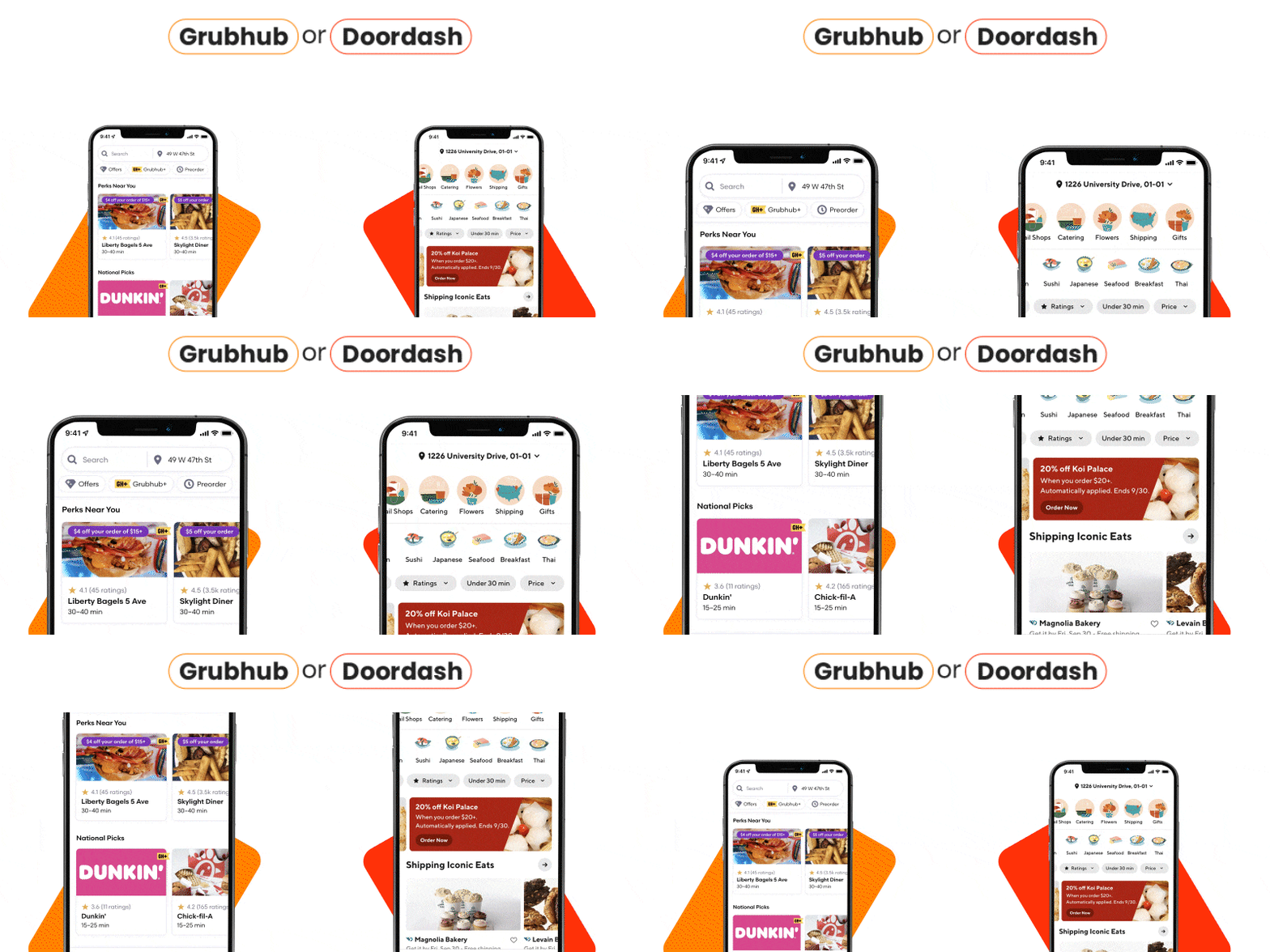
Here is how working for Grubhub vs DoorDash feels different in terms of app experience and user interface:
App Experience
App experience is about seamlessly moving your orders from the customer’s end to the restaurant kitchen and to delivery partners without disrupting the workflow and maintaining complete control over the process. Your application experience directly affects your order count, review count, and repeat customer count.
Here’s how DoorDash and Grubhub compare when it comes to app experience:
| App Experience Factor | DoorDash | Grubhub | Why This Matters |
|---|---|---|---|
| Number of Orders | Very High | Moderate | High volume doesn’t mean high profit margin |
| Delivery Speed | Fast | Slow | Speed directly affects user reviews and brand reputation |
| Issue Resolution | Strict rules | Flexible rules | Higher restrictions can hurt user trust |
| Operational Pressure | High | Moderate | Pressure to deliver orders quickly can compromise quality |
| Scalability | Built for rapid scaling | Built for controlled growth | Growth without some control can affect your ROI |
User Interface
The user interface is not only about look and feel. From the founder’s perspective, it’s more about how much control you have over the proceedings, how quickly you can fix any issues, and how well you understand the problems that are hurting your profit margins.
Here’s how Grubhub and DoorDash fare in terms of user interface:
| User Interface Factor | DoorDash | Grubhub | Business Impact |
|---|---|---|---|
| Dashboard | Data heavy | Clean and simple | Clarity directly translates to faster decisions |
| Refund | Limited Transparency | Clear breakdown | More transparency means fewer surprises at the time of payments |
| Menu & Pricing | Too many steps | Simple to manage | Complicated steps can lead to many lost orders |
| Support Access | Slow | Fast | A delay in customer support can damage brand reputation |
| Brand Control | Limited control | Slightly more control | Businesses want ownership and not too much dependency on the platform |
- If you want speed and scale, choose DoorDash.
- If you value control and clarity, choose Grubhub.
DoorDash vs Grubhub: User Reviews & Ratings
User reviews and ratings are not just numbers; they are indicators of customer satisfaction, brand value, and delivery reliability, which directly affect repeat orders, dispute resolution costs, and profit margins.
Here’s a summary of user reviews and ratings, which will help you to know whether to choose DoorDash or Grubhub:
| Platform | App Store | Google Play Store |
|---|---|---|
| DoorDash | Ratings: 4.8/5 Reviews: 21 million |
Ratings: 4.7/5 Reviews: 5.7 million |
| Grubhub | Ratings: 4.8/5 Reviews: 4.5 million |
Ratings: 4.5/5 Reviews: 963K |
- If you want to choose purely based on what users are saying, choose DoorDash, as it wins on scale and consistency.
- If you’re operating in a niche market and want a predictable revenue source, choose Grubhub.
DoorDash vs Grubhub: Pay For Drivers and Restaurant Partners
At the end of the day, business is all about making money, especially for early and growth-stage food startup founders. That’s why knowing the Grubhub vs DoorDash fees for drivers and restaurant partners plays a massive role in deciding which platform to choose.
The driver’s earnings directly affect delivery speed and ratings, while the restaurant payout determines whether the number of orders can improve the business’s profitability. Let’s analyze both these factors in detail.
Pay For Drivers
If you carefully evaluate Grubhub and DoorDash for drivers, you will see differences in their payment structures. While DoorDash focuses more on the number of orders and has a lower base pay, Grubhub offers higher pre-delivery payouts with fewer orders.
Let’s analyze Grubhub vs DoorDash driver pay in detail:
| Pricing Element | DoorDash | Grubhub |
|---|---|---|
| Base Pay Per Delivery | USD 2-USD 10 | USD 4-USD 12 |
| Tips | 100% passed to drivers | 100% passed to drivers |
| Incentives | Peak pay during high demand | Block-based bonuses |
| Order Volume | High volume, low pay | Low volume, high pay |
| Payout Schedule | Weekly | Weekly |
Pay For Restaurant Partners
From a founder’s perspective, Grubhub vs DoorDash pay for restaurants directly affects your profit margins. While DoorDash can increase the number of orders, Grubhub can help ensure a more predictable revenue stream for your restaurant.
| Pricing Element | DoorDash | Grubhub |
|---|---|---|
| Commission Fees | 15-30% per order (tier-based) | 15-30% per order (plan-based) |
| Delivery Fees | Tier based | Charged seperately or in a bundle |
| Marketing Fees | Paid promotion is costly | Paid promotion is more affordable |
| Margin Impact | Profit margin is low | Profit margin is more stable |
| Payout Schedule | Weekly | Weekly |
DoorDash vs Grubhub: Business & Revenue Model Comparison
Startup founders often face a difficult choice when evaluating the pros and cons of delivering for Grubhub vs DoorDash. That’s where knowing the DoorDash business model and the Grubhub business model can help you. It will provide you with detailed information, including fees, commissions, and subscription charges, so that you can make informed decisions.
Business & Revenue Model
Let’s decode the business and revenue models of Grubhub and DoorDash to understand their fee and commission structures.
| Revenue Factor | DoorDash | Grubhub |
|---|---|---|
| Restaurant Commission | 15% | 25% |
| Delivery Fee (Customer Pay) | USD 1.99–USD 7.99 per order | USD 2–USD 8 per order |
| Service Fee (Customer Pay) | 15% of the total order | 5% of the total order |
| Small Order Fee | USD 2.50 for orders below the minimum order value | USD 2.50–USD 3 for orders below the minimum order value |
| Driver Pay | Low | High |
| Subscription | DashPass USD 9.99/mo | Grubhub+ USD 9.99/mo |
| Marketing & Promotions | Paid placement/Featured listing | Sponsored listing/Ads |
DoorDash vs Grubhub: Which Is the Best?
If you’re comparing DoorDash vs Grubhub purely on ROI, then you will find out there’s no clear-cut winner in this race. It all depends on your individual business requirements.
DoorDash can give you reach, fast delivery, and consistent orders, but it comes with massive commission and promotion costs. On the other hand, Grubhub can perform better in niche markets and provide a more predictable revenue stream, but scaling can be an issue.
Your final call depends on:
- How much commission can you afford to pay
- Whether you need more orders or a higher profit margin
- How much control do you want over the customer data
- How much risk are you willing to take
However, if you’re fed up with third-party food delivery platforms and want to develop your own, aPurple is here to help. We’re a top-rated startup app development company with 10+ years of experience and have delivered 300+ on-demand solutions, including food delivery apps. So, we know what it takes to make a winning food delivery business.
Ready to develop a food delivery app that makes money? Connect with our experts and avail a detailed roadmap to success.
FAQs